 뒤로
Photosynthesis and Cellular Reproduction: Structure, Function, and Evolutionary Context
스터디 가이드 - 스마트 노트
 자료에 맞춘 맞춤형 노트, 핵심 정의, 예시, 맥락을 확장해 제공합니다.
Photosynthesis: Structure and Function
Photopigments and Light Absorption
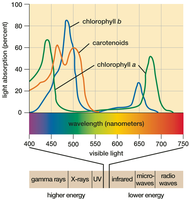
Photopigments are specialized molecules in plants that absorb light energy for photosynthesis. The main photopigments include chlorophyll a, chlorophyll b, and accessory pigments such as carotenoids and anthocyanins. Each pigment absorbs light at specific wavelengths, maximizing the plant's ability to capture solar energy.
Chlorophyll a: Directly participates in light reactions; absorbs mainly blue-violet and red light.
Chlorophyll b: Absorbs mainly blue and orange light, broadening the spectrum of light used.
Accessory pigments: Absorb wavelengths not covered by chlorophylls and transfer energy to chlorophyll a.
Accessory Pigments: Carotenoids and Anthocyanins
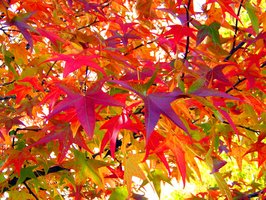
Accessory pigments play a crucial role in protecting plants from excessive light and attracting pollinators. Carotenoids are responsible for yellow-orange colors in fall foliage, while anthocyanins produce deep purples and blues.
Carotenoids: Absorb and dissipate excess light energy, preventing damage to chlorophyll.
Anthocyanins: Attract pollinators and provide protection against UV radiation.

Human Nutrients from Plant Pigments
Some carotenoids are essential nutrients for humans. Beta-carotene is converted to vitamin A, and lycopene is an antioxidant studied for its potential anti-cancer properties.
Beta-carotene: Found in pumpkins, sweet potatoes, and carrots; precursor to vitamin A.
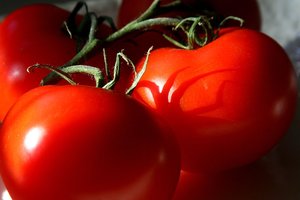
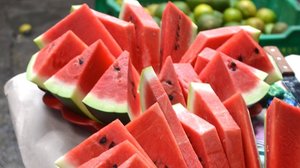
Lycopene: Found in tomatoes, watermelon, and red peppers; antioxidant.


Chloroplast Structure
Organization of the Chloroplast
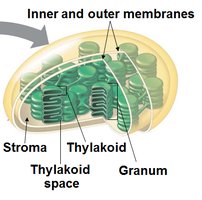
Chloroplasts are the site of photosynthesis in plant cells. They have a double-membrane envelope and contain internal structures essential for capturing light energy.
Stroma: Thick fluid inside the inner membrane.
Thylakoids: Membranous sacs suspended in the stroma; contain chlorophyll molecules.
Grana: Stacks of thylakoids where light reactions occur.
Overview of Photosynthesis
Two Main Stages
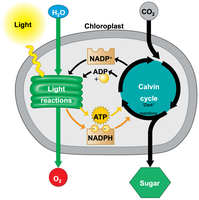
Photosynthesis consists of two interconnected stages: the light-dependent reactions and the Calvin cycle.
Light-dependent reactions: Photons excite electrons, producing ATP and NADPH.
Calvin cycle: Uses ATP, NADPH, and CO2 to synthesize carbohydrates.
Light Reactions
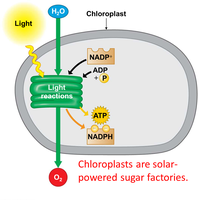
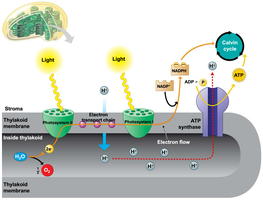
The light reactions transform solar energy into chemical energy in the form of ATP and NADPH. Chlorophyll in thylakoid membranes absorbs light, and a water-splitting enzyme provides electrons, releasing O2 as a by-product.
Water-splitting enzyme: Splits water to provide electrons and releases oxygen.
ATP and NADPH: Produced and used in the Calvin cycle.
Calvin Cycle
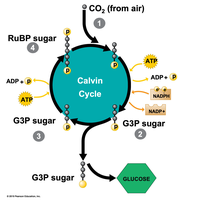
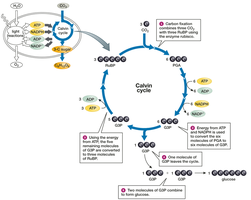
The Calvin cycle incorporates atmospheric CO2 to produce sugars. ATP and NADPH from the light reactions are used to form covalent bonds, resulting in molecules with higher potential energy than CO2.
Carbon fixation: Incorporation of CO2 into organic molecules.
Energy transfer: ATP and NADPH drive the synthesis of carbohydrates.
Photosystems and Electron Transport
Photosystems II and I
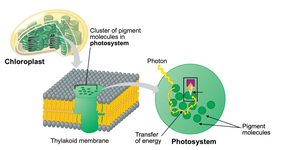
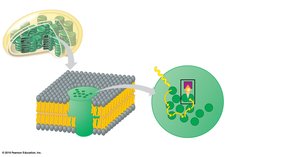
Photosystems are clusters of pigment molecules that function as light-gathering antennas. Photosystem II contains the water-splitting enzyme, and both photosystems utilize different wavelengths to excite electrons.
Photosystem II: Initiates electron flow by splitting water.
Photosystem I: Further excites electrons for NADPH production.
ATP and NADPH Generation
An electron transport chain (ETC) pumps hydrogen ions across the thylakoid membrane, creating a gradient. ATP synthase uses this gradient to produce ATP. The main difference between ETC in mitochondria and chloroplasts is the source of high-energy electrons: food in respiration, light in photosynthesis.
Electron transport chain: Transfers electrons and pumps H+ ions.
ATP synthase: Uses H+ gradient to synthesize ATP.
Calvin Cycle: Inputs, Outputs, and Regulation
Inputs and Outputs
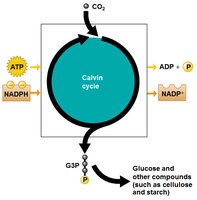
The Calvin cycle uses CO2, ATP, and NADPH to produce G3P, a sugar that can be converted into glucose. ADP and NADP+ are recycled back into the light reactions.
Inputs: CO2 (from air), ATP, NADPH (from light reactions).
Outputs: G3P (sugar), ADP, NADP+ (recycled).
RuBisCo and RuBP Cycling
RuBisCo is the enzyme responsible for carbon fixation in the Calvin cycle. It catalyzes the bonding of CO2 to RuBP, a 5-carbon molecule. G3P produced can be converted to glucose or recycled to regenerate RuBP, ensuring the cycle continues efficiently.
RuBisCo: Most abundant protein on Earth; catalyzes carbon fixation.
RuBP: 5-carbon molecule regenerated in the cycle.
G3P: Can exit the cycle as glucose or be used to replenish RuBP.
Energy Cycling and Evolutionary Context
Photosynthesis and Cellular Respiration
Photosynthesis and cellular respiration are interconnected processes. The reactants of photosynthesis (CO2 and H2O) are the waste products of respiration, and vice versa. Photosynthesis produces glucose and O2, which are used in respiration.
Photosynthesis: Converts solar energy to chemical energy.
Respiration: Uses glucose and O2 to produce ATP.
Evolutionary Significance
Photosynthesis dramatically changed Earth's atmosphere by increasing O2 levels. Ancient prokaryotes relied on glycolysis for ATP production before the emergence of photosynthetic organisms. The accumulation of O2 enabled aerobic respiration and shaped the evolution of life.
Glycolysis: Universal energy-harvesting process.
Photosynthesis: Responsible for atmospheric O2 increase.
Cell Cycle and Cellular Reproduction
Cell Cycle Overview
The cell cycle is a series of stages in the life of a cell, including DNA replication and division. Mitosis is the most prevalent type, resulting in two genetically identical daughter cells.
DNA replication: Ensures each daughter cell receives an identical genome.
Mitosis: One cell splits into two identical cells.
DNA Structure and Chromosomes
DNA is the essential link between generations, consisting of two long chains of nucleotides forming a double helix. Chromosomes are organized sections of DNA containing genes. Eukaryotes have linear chromosomes in the nucleus, while prokaryotes have a single circular chromosome.
Genome: All chromosomes in a cell.
Chromosome organization: Varies among species.
DNA Packing and Cell Division Functions
DNA is tightly packed with histones to facilitate replication and division. Mitotic cell division serves three main functions: replacing damaged or lost cells, permitting growth, and enabling asexual reproduction.
Histones: Proteins that help organize and pack DNA.
Cell division: Essential for growth, repair, and reproduction.
Function | Description |
|---|---|
Replacement | Replaces damaged or lost cells |
Growth | Permits organismal growth |
Asexual Reproduction | Produces genetically identical offspring |
Example: Regeneration of a sea star, growth of a plant clipping, and replacement of human kidney cells.
Additional info: The notes provide a comprehensive overview of photosynthesis, cellular respiration, and cell cycle, covering key concepts relevant to General Biology.
