 뒤로
뒤로Psychopharmacology: Biological Foundations of Drug Action and Addiction
스터디 가이드 - 스마트 노트
 자료에 맞춘 맞춤형 노트, 핵심 정의, 예시, 맥락을 확장해 제공합니다.
Psychopharmacology: Biological Foundations of Drug Action and Addiction
Drugs and Their Biological Effects
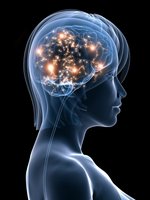
Psychopharmacology is the study of how drugs affect the brain and behavior. Drugs can alter physiological and psychological processes by interacting with the nervous system, particularly at the level of synaptic transmission.
Drug: Any non-required substance that changes the body or its functioning.
Psychoactive drugs: Substances that have psychological effects, such as anxiety relief or hallucinations.
Aspects of Drug Action
Pharmacokinetics: The process by which drugs are absorbed, distributed, metabolized, and excreted.
Pharmacodynamics: The effects of drugs at their receptor sites. Receptors detect endogenous ligands (naturally occurring molecules), while drugs act as exogenous ligands.
Synaptic Transmission and Drug Action
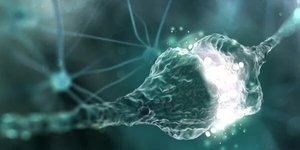
Drugs can affect synaptic transmission by mimicking, enhancing, or blocking the action of neurotransmitters at synapses.
The effect depends on the type of neurotransmitter released and the type of postsynaptic receptor activated.
Agonists and Antagonists
Drugs can be classified based on their action at receptors:
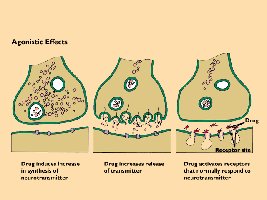
Agonists: Mimic or enhance the action of neurotransmitters.
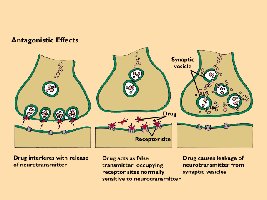
Antagonists: Block or decrease the action of neurotransmitters.
Major Neurotransmitter Systems and Drug Interactions
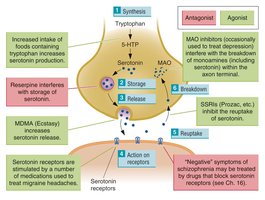
Serotonin (5-HT) and Drugs
Serotonin is involved in mood, appetite, and sleep. Drugs can act as agonists or antagonists at serotonin receptors.
Agonists: Tryptophan (precursor), MDMA (increases release), SSRIs (block reuptake).
Antagonists: Drugs that destroy the enzyme converting tryptophan to serotonin.
Acetylcholine (ACh) and Drugs
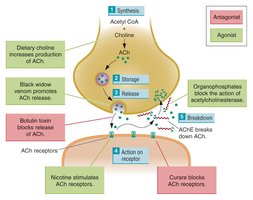
Acetylcholine is essential for muscle action, learning, and memory. Drugs can affect its synthesis, release, breakdown, and receptor binding.
Agonists: Nicotine stimulates ACh receptors.
Antagonists: Curare blocks ACh receptors; botulinum toxin blocks release.
Dopamine (DA) and Reward Pathways
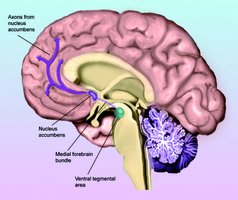
Dopamine is involved in movement, reinforcement, and planning. It is central to the brain's reward system and is affected by many drugs of abuse.
Nigrostriatal pathway: Substantia nigra to striatum (motor control).
Mesolimbocortical pathway: VTA to limbic system and cortex (reward).
Drug-Dopamine Interactions
Antipsychotics: Block DA receptors (D2).
L-dopa: Increases DA synthesis.
Cocaine: Blocks DA reuptake, increasing synaptic DA.
Amphetamines: Increase DA release.
MAO inhibitors: Block breakdown of DA.
Classes of Psychoactive Drugs
Opioids and Opiates
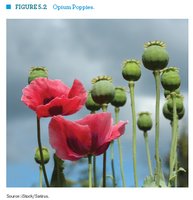
Opioids include both natural (opiates) and synthetic drugs that act on endogenous opioid receptors, producing analgesia, euphoria, and high abuse potential.
Examples: Morphine, heroin, oxycontin, fentanyl.
High risk of tolerance, dependence, and withdrawal symptoms.

Depressants
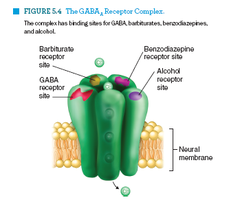
Depressants reduce nervous system activity, producing sedation, anxiolysis, and hypnosis. Alcohol is the most commonly used depressant.
Alcohol: Acts as an agonist at GABA, opiate, dopamine, serotonin, and cannabinoid receptors; antagonist at glutamate and acetylcholine receptors.
Withdrawal from depressants can be dangerous and life-threatening.
Stimulants
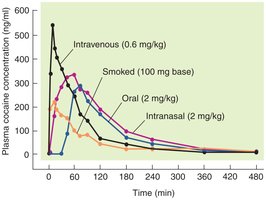
Stimulants increase arousal, alertness, and euphoria. They include amphetamines, methamphetamines, and cocaine.
Cocaine: Potent DA agonist, blocks reuptake, increases synaptic DA.
Amphetamines: Increase release of DA and other monoamines.
Psychedelics
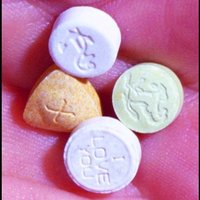
Psychedelics cause perceptual distortions and hallucinations. Examples include LSD, psilocybin, and MDMA (Ecstasy).
MDMA increases serotonin release and blocks reuptake.
Cannabis/Marijuana
Marijuana contains THC, which binds to cannabinoid receptors in the brain and body. Effects include mild sedation, altered perception, and impaired cognitive function.
THC: Binds to CB1 (brain) and CB2 (immune system) receptors.
Little cross-tolerance with other depressants.


Drug Tolerance, Dependence, and Addiction
Tolerance
Tolerance is a decrease in drug effectiveness with repeated use. Types include:
Dispositional (metabolic): Increased drug metabolism.
Functional: CNS becomes less sensitive (acute and protracted).
Behavioral/learned: Conditioned compensation.
Cross-tolerance: Tolerance to similar drugs.
Mixed (differential): Tolerance to some effects but not others.
Reverse (sensitization): Increased response with repeated use.
Dependence and Withdrawal
Physical dependence: Adaptive state with tolerance and withdrawal symptoms upon cessation.
Withdrawal: Symptoms are typically opposite to drug effects and may involve conditioned responses.
Addiction
Addiction is characterized by compulsive drug use, preoccupation, and high relapse rates. It involves both positive and negative reinforcement mechanisms in the brain.
Major reward system: mesolimbocortical dopamine pathway (VTA to nucleus accumbens).
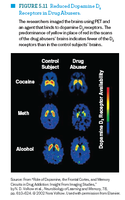
Chronic use leads to neural adaptations, including reduced dopamine receptor availability and hypofrontality (reduced prefrontal cortex activity).
Principles of Psychopharmacology
Routes of Administration
Intravenous (IV): Directly into a vein.
Intraperitoneal (IP): Into the peritoneal cavity.
Intramuscular (IM): Into a muscle.
Subcutaneous (SC): Beneath the skin.
Oral: Swallowed.
Sublingual: Beneath the tongue.
Intrarectal: Into the rectum.
Inhalation: Into the lungs.
Topical: Absorbed through the skin.
Drug Effectiveness and Repeated Administration
Affinity: The readiness with which two molecules join together.
Tolerance: Decreased effectiveness with repeated use.
Sensitization: Increased effectiveness with repeated use.
Withdrawal symptoms: Appear when drug use is stopped; typically opposite to drug effects.
Placebo Effects
Placebos are inert substances used as controls in experiments to distinguish drug effects from psychological effects of administration.
Essential for determining the true behavioral effects of drugs in humans.
Summary Table: Major Classes of Psychoactive Drugs
Class | Main Effects | Examples |
|---|---|---|
Opioids/Opiates | Analgesia, euphoria, sedation | Morphine, heroin, fentanyl |
Depressants | Sedation, anxiolysis, hypnosis | Alcohol, benzodiazepines |
Stimulants | Increased arousal, alertness, euphoria | Cocaine, amphetamines |
Psychedelics | Perceptual distortions, hallucinations | LSD, psilocybin, MDMA |
Marijuana | Mild sedation, altered perception, appetite increase | THC (Cannabis sativa/indica) |
Additional info: This summary integrates foundational concepts from general biology and neuroscience, including neurotransmitter systems, synaptic transmission, and the biological basis of addiction, as relevant to the study of psychopharmacology.
