 뒤로
The Central Dogma, Genetic Code, and Mutations: From DNA to Protein and Beyond
스터디 가이드 - 스마트 노트
 자료에 맞춘 맞춤형 노트, 핵심 정의, 예시, 맥락을 확장해 제공합니다.
The Central Dogma of Molecular Biology
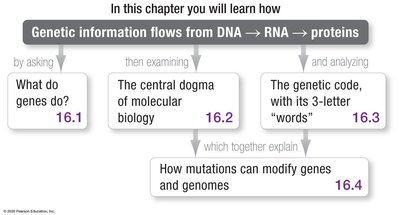
Overview of Genetic Information Flow
The central dogma of molecular biology describes the directional flow of genetic information within a cell: DNA → RNA → Protein. This process explains how genetic instructions are used to synthesize proteins, which determine an organism’s traits.
Genes are segments of DNA that encode instructions for building proteins.
DNA’s sequence of four bases (A, T, C, G) stores genetic information.
Proteins are not synthesized directly from DNA; instead, an intermediate molecule, RNA, is involved.
The Genetic Code Hypothesis
Francis Crick proposed that the sequence of DNA bases acts as a code for amino acids, the building blocks of proteins. Each gene specifies the amino acid sequence of one protein, but the information is not directly translated; an intermediate is required.
DNA is an information storage molecule.
Different combinations of bases specify the 20 amino acids found in proteins.
The genetic code is the set of rules by which information encoded in DNA is translated into proteins.
RNA as the Intermediary
Messenger RNA (mRNA) serves as the intermediary between DNA and protein synthesis. It carries genetic information from the nucleus (where DNA is located) to the cytoplasm (where proteins are made).
RNA polymerase synthesizes RNA using a DNA template, matching complementary nucleotides.
mRNA connects the genetic code in DNA to the protein-building machinery in the cytoplasm.
The Central Dogma Explained
The central dogma summarizes the flow of information in cells:
Transcription: DNA is used as a template to make complementary RNA (mRNA).
Translation: The mRNA sequence is used to synthesize proteins by interpreting nucleotide sequences as amino acids.
Genotype and Phenotype
An organism’s genotype is determined by its DNA sequence, while its phenotype is the result of the proteins it produces. Different alleles (versions) of a gene can lead to different protein products and thus different phenotypes.
Modifications to the Central Dogma
There are exceptions and additions to the central dogma:
Some genes code for RNAs that are not translated into proteins but have important cellular functions (e.g., rRNA, tRNA).
In some viruses, information can flow from RNA back to DNA via reverse transcriptase.
The Genetic Code
Structure and Properties of the Genetic Code
The genetic code specifies how sequences of nucleotides in mRNA are translated into amino acids. Each group of three nucleotides (a codon) codes for one amino acid.
The code is a triplet code: three bases per codon.
There are 64 possible codons (43 combinations), but only 20 amino acids, so the code is redundant (more than one codon can specify the same amino acid).
The code is unambiguous (each codon specifies only one amino acid), non-overlapping (codons are read one at a time), nearly universal (shared by almost all organisms), and conservative (codons for the same amino acid often share the first two bases).
Cracking the Genetic Code
Researchers like Nirenberg and Matthaei determined which codons specify which amino acids by synthesizing artificial RNAs and observing which amino acids were incorporated into proteins.
Start codon (AUG): Codes for methionine and signals the start of protein synthesis.
Stop codons (UAA, UAG, UGA): Signal the end of the protein-coding sequence.
Using the Genetic Code
Knowing the genetic code allows biologists to:
Predict the amino acid sequence from a DNA or mRNA sequence.
Determine possible DNA or mRNA sequences that could code for a given amino acid sequence (due to redundancy, multiple sequences may code for the same protein).
Mutations: Types and Consequences
Definition and Types of Mutations
A mutation is any permanent change in an organism’s DNA. Mutations can alter the genotype and may result in new alleles. They are classified by their scale and effect:
Point mutations: Changes in a single or a few nucleotides.
Chromosome-level mutations: Large-scale changes affecting chromosome structure or number.
Types of Point Mutations
Missense mutation: Changes an amino acid in the protein.
Silent mutation: Does not change the amino acid sequence (due to redundancy).
Frameshift mutation: Addition or deletion of nucleotides shifts the reading frame, altering all downstream codons.
Nonsense mutation: Changes a codon to a stop codon, leading to premature termination of translation.
Effects of Mutations on Fitness
Beneficial mutations: Increase an organism’s fitness (ability to survive and reproduce).
Neutral mutations: Have no effect on fitness.
Deleterious mutations: Decrease fitness.
Most point mutations are neutral or deleterious. Some mutations outside coding regions can affect gene expression and phenotype.
Chromosome Mutations
Chromosome mutations can change chromosome number or structure:
Inversion: Segment breaks off, flips, and rejoins.
Translocation: Segment breaks off and attaches to another chromosome.
Deletion: Segment is lost.
Duplication: Segment is present in multiple copies.
Consequences of Chromosome Mutations
Like point mutations, chromosome mutations can be beneficial, neutral, or deleterious.
Chromosome mutations are common in cancer cells and can be visualized using a karyotype (complete set of chromosomes in a cell).
Summary Table: Consequences of Point Mutations
The following table summarizes the main types of point mutations, their definitions, examples, and consequences:
Name | Definition | Example | Consequence |
|---|---|---|---|
Silent | Change in nucleotide sequence that does not change the amino acid specified by a codon | UAU → UAC (both code for Tyr) | No change in phenotype; neutral with respect to fitness |
Missense | Change in nucleotide sequence that changes the amino acid specified by a codon | UAU → UGU (Tyr → Cys) | Change in primary structure of protein; may be beneficial, neutral, or deleterious |
Nonsense | Change in nucleotide sequence that results in an early stop codon | UAU → UAA (Tyr → Stop) | Leads to mRNA breakdown or shortened polypeptide; usually deleterious |
Frameshift | Addition or deletion of a nucleotide | UAU GGC → UAG GCA (reading frame shifted) | Reading frame is shifted, altering the meaning of all subsequent codons; almost always deleterious |
Key Takeaways
The central dogma explains how genetic information flows from DNA to RNA to protein.
The genetic code is a triplet code that is redundant, unambiguous, and nearly universal.
Mutations can alter genetic information at the nucleotide or chromosome level, with varying effects on phenotype and fitness.
