
The following diagrams represent mixtures of NO(g) and O21g2. These two substances react as follows: 2 NO1g2 + O21g2¡2 NO21g2 It has been determined experimentally that the rate is second order in NO and first order in O2. Based on this fact, which of the following mixtures will have the fastest initial rate? [Section 14.3]
Ch.14 - Chemical Kinetics
14장, 문제 7b
Given the following diagrams at t = 0 min and t = 30 min

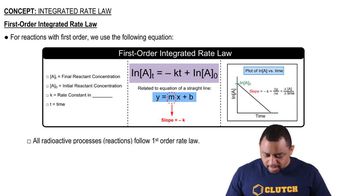
After four half-life periods for a first-order reaction, what fraction of reactant remains? [Section 14.4]
검증된 단계별 안내1
Identify that the problem involves a first-order reaction and the concept of half-life.
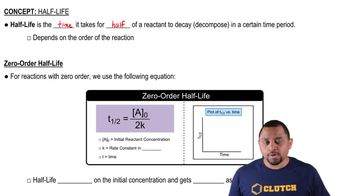
Recall that for a first-order reaction, the half-life (t_1/2) is the time required for the concentration of the reactant to decrease by half.
Understand that after one half-life, the concentration of the reactant is reduced to 1/2 of its initial value.
After two half-lives, the concentration is reduced to (1/2)^2 = 1/4 of its initial value.
After four half-lives, the concentration is reduced to (1/2)^4 = 1/16 of its initial value.

비슷한 문제에 대한 검증된 영상 답변:
이 영상 해법은 위 문제에 도움이 된다고 튜터들이 추천한 것입니다.
영상 길이:
58s주요 개념
질문에 올바르게 답하기 위해 반드시 이해해야 하는 핵심 개념들은 다음과 같습니다.
First-Order Reaction
A first-order reaction is a type of chemical reaction where the rate is directly proportional to the concentration of one reactant. This means that as the concentration of the reactant decreases, the rate of the reaction also decreases. The mathematical representation of a first-order reaction is given by the equation: rate = k[A], where k is the rate constant and [A] is the concentration of the reactant.
추천 영상:
가이드 코스
First-Order Reactions
Half-Life
The half-life of a reaction is the time required for the concentration of a reactant to decrease to half of its initial value. For first-order reactions, the half-life is constant and does not depend on the initial concentration. This property allows for easy calculations of remaining reactant concentration over multiple half-lives, making it a crucial concept in kinetics.
추천 영상:
가이드 코스
Zero-Order Half-life
Fraction of Reactant Remaining
The fraction of reactant remaining after a certain number of half-lives can be calculated using the formula: (1/2)^n, where n is the number of half-lives that have passed. For example, after four half-lives, the fraction remaining would be (1/2)^4 = 1/16. This concept is essential for understanding how reactant concentrations change over time in a first-order reaction.
추천 영상:
가이드 코스
Mole Fraction Formula
관련 실천
교과서 질문
748
views
교과서 질문
You study the rate of a reaction, measuring both the concentration of the reactant and the concentration of the product as a function of time, and obtain the following results:
Which chemical equation is consistent with these data: (i) A → B, (ii) B → A, (iii) A → 2 B, (iv) B → 2 A?
719
views
교과서 질문
Suppose that for the reaction K + L → M, you monitor the production of M over time, and then plot the following graph from your data:
(b) Is the reaction completed at t = 15 min? [Section 14.2]
369
views
교과서 질문
Which of the following linear plots do you expect for a reaction A¡products if the kinetics are (a) zero order, [Section 14.4]
652
views
