
Ch.14 - Chemical Kinetics
Brown - Chemistry: The Central Science 14th Edition
Brown14th EditionChemistry: The Central ScienceISBN: 9780134414232당신이 사용하는 게 아니라요?교과서 변경
14장, 문제 5

The following diagrams represent mixtures of NO(g) and O21g2. These two substances react as follows: 2 NO1g2 + O21g2¡2 NO21g2 It has been determined experimentally that the rate is second order in NO and first order in O2. Based on this fact, which of the following mixtures will have the fastest initial rate? [Section 14.3]
Diagrams I, II, and III show mixtures of NO and O2 for rate law analysis.

검증된 단계별 안내
1
Identify the reactants and their respective orders in the rate law. Here, NO is second order and O2 is first order.
Count the number of NO (blue spheres) and O2 (orange spheres) molecules in each diagram.
For Diagram I: Count the number of NO and O2 molecules.
For Diagram II: Count the number of NO and O2 molecules.
For Diagram III: Count the number of NO and O2 molecules.

비슷한 문제에 대한 검증된 영상 답변:

이 영상 해법은 위 문제에 도움이 된다고 튜터들이 추천한 것입니다.
영상 길이:
1m

주요 개념

질문에 올바르게 답하기 위해 반드시 이해해야 하는 핵심 개념들은 다음과 같습니다.

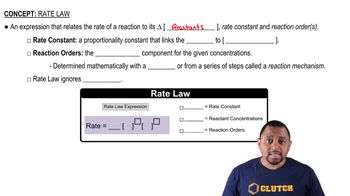
Rate Law

The rate law expresses the relationship between the rate of a chemical reaction and the concentration of its reactants. It is determined experimentally and indicates how the rate depends on the concentration of each reactant raised to a power, which corresponds to its order in the reaction. For the given reaction, the rate law is rate = k[NO]^2[O2]^1, showing that the reaction is second order in NO and first order in O2.
추천 영상:
가이드 코스
01:52
Rate Law Fundamentals

Reaction Order

Reaction order refers to the exponent of a reactant's concentration in the rate law, indicating how the rate of reaction changes with varying concentrations. A second-order reaction in a reactant means that doubling its concentration will quadruple the reaction rate, while a first-order reaction means that doubling the concentration will double the rate. Understanding the order helps predict how different mixtures will affect the initial reaction rate.
추천 영상:
가이드 코스
00:36
Average Bond Order

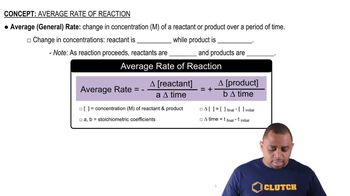
Initial Rate of Reaction

The initial rate of reaction is the speed at which reactants are converted to products at the very beginning of the reaction, typically measured right after the reactants are mixed. It is influenced by the concentrations of the reactants and their respective orders in the rate law. To determine which mixture has the fastest initial rate, one must calculate the rate using the concentrations of NO and O2 in each mixture according to the established rate law.
추천 영상:
가이드 코스
02:03
Average Rate of Reaction