
Ch.14 - Chemical Kinetics
Brown - Chemistry: The Central Science 14th Edition
Brown14th EditionChemistry: The Central ScienceISBN: 9780134414232당신이 사용하는 게 아니라요?교과서 변경
14장, 문제 87a

The activation energy of an uncatalyzed reaction is 95 kJ/mol. The addition of a catalyst lowers the activation energy to 55 kJ/mol. Assuming that the collision factor remains the same, by what factor will the catalyst increase the rate of the reaction at (a) 25 C

검증된 단계별 안내
1
Identify the Arrhenius equation: \( k = A e^{-\frac{E_a}{RT}} \), where \( k \) is the rate constant, \( A \) is the pre-exponential factor, \( E_a \) is the activation energy, \( R \) is the gas constant, and \( T \) is the temperature in Kelvin.
Convert the temperature from Celsius to Kelvin: \( T = 25 + 273.15 \).
Calculate the rate constant for the uncatalyzed reaction using the activation energy of 95 kJ/mol: \( k_1 = A e^{-\frac{95000}{8.314 \times T}} \).
Calculate the rate constant for the catalyzed reaction using the activation energy of 55 kJ/mol: \( k_2 = A e^{-\frac{55000}{8.314 \times T}} \).
Determine the factor by which the catalyst increases the rate of the reaction by taking the ratio \( \frac{k_2}{k_1} \).

비슷한 문제에 대한 검증된 영상 답변:

이 영상 해법은 위 문제에 도움이 된다고 튜터들이 추천한 것입니다.

주요 개념

질문에 올바르게 답하기 위해 반드시 이해해야 하는 핵심 개념들은 다음과 같습니다.

Activation Energy

Activation energy is the minimum energy required for a chemical reaction to occur. It represents the energy barrier that reactants must overcome to transform into products. A higher activation energy means that fewer molecules have sufficient energy to react, resulting in a slower reaction rate. Conversely, lowering the activation energy, such as through the use of a catalyst, increases the likelihood of successful collisions between reactant molecules.
추천 영상:
가이드 코스
02:02
Activity Series Chart

Catalysts

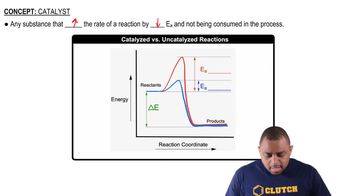
Catalysts are substances that increase the rate of a chemical reaction without being consumed in the process. They work by providing an alternative reaction pathway with a lower activation energy. This allows more reactant molecules to have enough energy to undergo the reaction, thus speeding up the reaction rate. Importantly, catalysts do not alter the equilibrium position of the reaction; they only affect the rate at which equilibrium is reached.
추천 영상:
가이드 코스
01:59
Catalyzed vs. Uncatalyzed Reactions

Arrhenius Equation

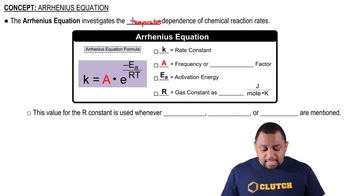
The Arrhenius equation describes the temperature dependence of reaction rates and relates the rate constant of a reaction to the activation energy and temperature. It is expressed as k = A * e^(-Ea/RT), where k is the rate constant, A is the pre-exponential factor, Ea is the activation energy, R is the universal gas constant, and T is the temperature in Kelvin. This equation illustrates how a decrease in activation energy, as seen with a catalyst, can significantly increase the reaction rate.
추천 영상:
가이드 코스
01:20
Arrhenius Equation