Ch.14 - Chemical Kinetics
Brown - Chemistry: The Central Science 14th Edition
Brown14th EditionChemistry: The Central ScienceISBN: 9780134414232당신이 사용하는 게 아니라요?교과서 변경
14장, 문제 86c

The enzyme urease catalyzes the reaction of urea, (NH2CONH2), with water to produce carbon dioxide and ammonia. In water, without the enzyme, the reaction proceeds with a first-order rate constant of 4.15 × 10⁻⁵ s-1 at 100°C. In the presence of the enzyme in water, the reaction proceeds with a rate constant of 3.4 × 10⁴ s-1 at 21°C. (c) In actuality, what would you expect for the rate of the catalyzed reaction at 100°C as compared to that at 21°C?

검증된 단계별 안내
1
Identify the reaction being catalyzed: Urea reacts with water to produce carbon dioxide and ammonia.
Understand that the rate of a reaction generally increases with temperature due to increased molecular motion and collision frequency.
Recognize that enzymes, like urease, are proteins that can denature at high temperatures, potentially reducing their catalytic activity.
Consider the Arrhenius equation, which relates the rate constant (k) to temperature (T): k = A * e^(-Ea/RT), where A is the pre-exponential factor, Ea is the activation energy, R is the gas constant, and T is the temperature in Kelvin.
Predict that while the rate constant for the catalyzed reaction at 100°C might be higher than at 21°C due to increased temperature, the enzyme's stability and activity at this higher temperature must also be considered, potentially leading to a decrease in the rate if the enzyme denatures.

비슷한 문제에 대한 검증된 영상 답변:

이 영상 해법은 위 문제에 도움이 된다고 튜터들이 추천한 것입니다.
영상 길이:
1m

주요 개념

질문에 올바르게 답하기 위해 반드시 이해해야 하는 핵심 개념들은 다음과 같습니다.

Enzyme Catalysis

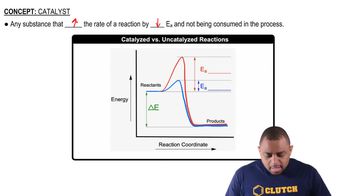
Enzyme catalysis refers to the process by which enzymes accelerate chemical reactions by lowering the activation energy required for the reaction to occur. This allows reactions to proceed at a much faster rate compared to uncatalyzed reactions. Enzymes are highly specific and can significantly increase the rate of reactions under physiological conditions, making them essential for biological processes.
추천 영상:
가이드 코스
01:59
Catalyzed vs. Uncatalyzed Reactions

Rate Constants and Temperature

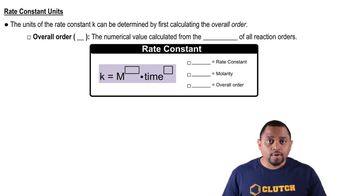
Rate constants are numerical values that indicate the speed of a reaction at a given temperature. According to the Arrhenius equation, the rate constant increases with temperature due to the increased kinetic energy of molecules, which leads to more frequent and effective collisions. Understanding how temperature affects rate constants is crucial for predicting reaction rates under different conditions.
추천 영상:
가이드 코스
00:45
Rate Constant Units

First-Order Reactions

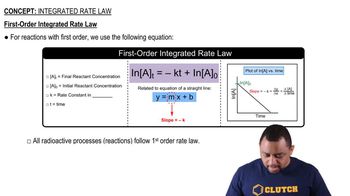
First-order reactions are those where the rate of reaction is directly proportional to the concentration of one reactant. This means that if the concentration of the reactant doubles, the reaction rate also doubles. The rate constant for first-order reactions is independent of the concentration of the reactant, making it a key concept in understanding how reaction rates change with the presence of catalysts and varying conditions.
추천 영상:
가이드 코스
02:29
First-Order Reactions