Ch.14 - Chemical Kinetics
Brown - Chemistry: The Central Science 14th Edition
Brown14th EditionChemistry: The Central ScienceISBN: 9780134414232당신이 사용하는 게 아니라요?교과서 변경
14장, 문제 86b

The enzyme urease catalyzes the reaction of urea, (NH2CONH2), with water to produce carbon dioxide and ammonia. In water, without the enzyme, the reaction proceeds with a first-order rate constant of 4.15 × 10⁻⁵ s-1 at 100°C. In the presence of the enzyme in water, the reaction proceeds with a rate constant of 3.4 × 10⁴ s-1 at 21°C. (b) If the rate of the catalyzed reaction were the same at 100°C as it is at 21°C, what would be the difference in the activation energy between the catalyzed and uncatalyzed reactions?

검증된 단계별 안내
1
Identify the given data: The rate constant for the uncatalyzed reaction at 100°C is 4.15 × 10^-5 s^-1, and for the catalyzed reaction at 21°C is 3.4 × 10^4 s^-1.
Understand that the problem asks for the difference in activation energy (Ea) between the catalyzed and uncatalyzed reactions if the catalyzed reaction rate constant were the same at 100°C as it is at 21°C.
Use the Arrhenius equation: k = A * e^(-Ea/(RT)), where k is the rate constant, A is the pre-exponential factor, Ea is the activation energy, R is the gas constant (8.314 J/mol·K), and T is the temperature in Kelvin.
Set up the Arrhenius equation for both reactions. For the uncatalyzed reaction at 100°C (373 K), use k1 = 4.15 × 10^-5 s^-1. For the catalyzed reaction at 100°C, assume k2 = 3.4 × 10^4 s^-1.
Calculate the difference in activation energy (ΔEa) using the equation: ln(k2/k1) = (Ea1 - Ea2) / (R * T), where Ea1 is the activation energy for the uncatalyzed reaction and Ea2 is for the catalyzed reaction. Rearrange to find ΔEa = Ea1 - Ea2.

비슷한 문제에 대한 검증된 영상 답변:

이 영상 해법은 위 문제에 도움이 된다고 튜터들이 추천한 것입니다.
영상 길이:
3m

주요 개념

질문에 올바르게 답하기 위해 반드시 이해해야 하는 핵심 개념들은 다음과 같습니다.

Enzyme Catalysis

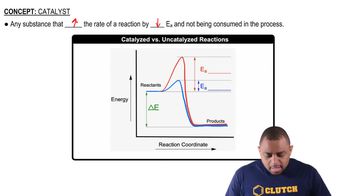
Enzymes are biological catalysts that speed up chemical reactions by lowering the activation energy required for the reaction to occur. They achieve this by providing an alternative reaction pathway, which stabilizes the transition state. In the case of urease, it facilitates the breakdown of urea into carbon dioxide and ammonia, significantly increasing the reaction rate compared to the uncatalyzed process.
추천 영상:
가이드 코스
01:59
Catalyzed vs. Uncatalyzed Reactions

Activation Energy

Activation energy is the minimum energy required for a chemical reaction to occur. It represents the energy barrier that reactants must overcome to form products. The presence of a catalyst, such as an enzyme, reduces this energy barrier, allowing reactions to proceed more quickly and at lower temperatures, which is crucial for biological processes.
추천 영상:
가이드 코스
02:02
Activity Series Chart

Arrhenius Equation

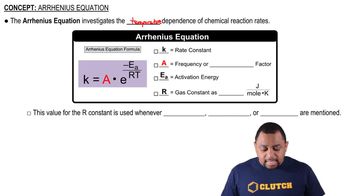
The Arrhenius equation relates the rate constant of a reaction to the temperature and activation energy. It is expressed as k = A * e^(-Ea/RT), where k is the rate constant, A is the pre-exponential factor, Ea is the activation energy, R is the gas constant, and T is the temperature in Kelvin. This equation is essential for comparing the effects of temperature and catalysts on reaction rates, allowing for the calculation of differences in activation energy between catalyzed and uncatalyzed reactions.
추천 영상:
가이드 코스
01:20
Arrhenius Equation