Ch.16 - Aqueous Equilibria: Acids & Bases
McMurry - Chemistry 8th Edition
McMurry8th EditionChemistryISBN: 9781292336145당신이 사용하는 게 아니라요?교과서 변경
16장, 문제 61

Calculate the percent dissociation of 0.10 M hydrazoic acid (HN3, Ka = 1.9 X 10^-5). Recalculate the percent dissociation of 0.10 M HN3 in the presence of 0.10 M HCl, and explain the change.

검증된 단계별 안내
1
insert step 1: Write the dissociation equation for hydrazoic acid (HN3) in water: HN3 (aq) ⇌ H+ (aq) + N3- (aq).
insert step 2: Set up the expression for the acid dissociation constant (Ka) for HN3: Ka = [H+][N3-]/[HN3].
insert step 3: Assume x is the concentration of H+ and N3- ions at equilibrium, and set up the equation: Ka = (x)(x)/(0.10 - x).
insert step 4: Solve for x using the approximation method, assuming x is small compared to 0.10 M, so 0.10 - x ≈ 0.10.
insert step 5: Calculate the percent dissociation using the formula: percent dissociation = (x/0.10) * 100%.

비슷한 문제에 대한 검증된 영상 답변:

이 영상 해법은 위 문제에 도움이 된다고 튜터들이 추천한 것입니다.
영상 길이:
10m

주요 개념

질문에 올바르게 답하기 위해 반드시 이해해야 하는 핵심 개념들은 다음과 같습니다.

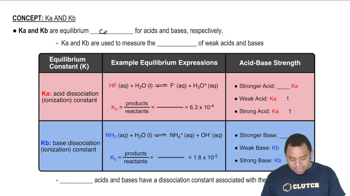
Dissociation Constant (Ka)

The dissociation constant (Ka) is a quantitative measure of the strength of an acid in solution. It represents the equilibrium constant for the dissociation of an acid into its conjugate base and hydrogen ions. A higher Ka value indicates a stronger acid that dissociates more completely in solution. For hydrazoic acid (HN3), the given Ka value of 1.9 x 10^-5 indicates it is a weak acid, which will only partially dissociate in water.
추천 영상:
가이드 코스
03:50
Characteristics of Ka and Kb

Percent Dissociation

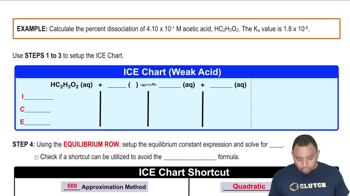
Percent dissociation is a way to express the extent to which an acid dissociates in solution. It is calculated by taking the amount of acid that has dissociated and dividing it by the initial concentration of the acid, then multiplying by 100. This concept is crucial for understanding the behavior of weak acids in different concentrations and environments, as it provides insight into their reactivity and strength in solution.
추천 영상:
가이드 코스
04:52
Percent Dissociation Example

Common Ion Effect

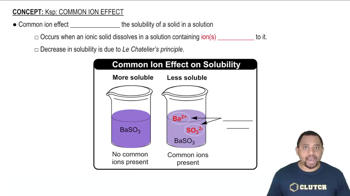
The common ion effect refers to the decrease in the solubility of an ionic compound when a common ion is added to the solution. In the case of adding HCl to a solution of HN3, the presence of H+ ions from HCl shifts the equilibrium of the dissociation of HN3 to the left, reducing its dissociation. This results in a lower percent dissociation of HN3 in the presence of HCl compared to its dissociation in pure water, illustrating the impact of competing equilibria in acid-base chemistry.
추천 영상:
가이드 코스
02:53
Common Ion Effect