Ch.16 - Aqueous Equilibria: Acids & Bases
McMurry - Chemistry 8th Edition
McMurry8th EditionChemistryISBN: 9781292336145당신이 사용하는 게 아니라요?교과서 변경
16장, 문제 62

Calculate the pH of 100.0 mL of 0.30 M NH3 before and after the addition of 4.0 g of NH4NO3, and account for the change. Assume that the volume remains constant.

검증된 단계별 안내
1
Identify the initial concentration of NH3, which is 0.30 M, and recognize that NH3 is a weak base.
Use the Kb expression for NH3 to calculate the initial pH. The Kb for NH3 is typically around 1.8 \(\times\) 10^{-5}. Set up the equation: Kb = \(\frac{[OH^-][NH4^+]}{[NH3]}\) and solve for [OH^-].
Convert [OH^-] to pOH using the formula pOH = -\(\log\)[OH^-], and then find the initial pH using pH = 14 - pOH.
Calculate the moles of NH4NO3 added: 4.0 g / (molar mass of NH4NO3). NH4NO3 dissociates completely in water to give NH4^+ and NO3^-.
Use the Henderson-Hasselbalch equation to find the new pH after adding NH4NO3: pH = pKa + \(\log\[\left\)(\(\frac{[base]}{[acid]}\]\right\)), where [base] is the concentration of NH3 and [acid] is the concentration of NH4^+.

비슷한 문제에 대한 검증된 영상 답변:

이 영상 해법은 위 문제에 도움이 된다고 튜터들이 추천한 것입니다.
영상 길이:
8m

주요 개념

질문에 올바르게 답하기 위해 반드시 이해해야 하는 핵심 개념들은 다음과 같습니다.

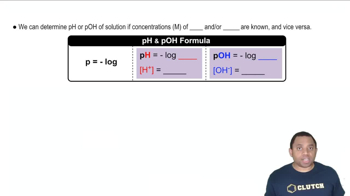
pH and pOH

pH is a measure of the hydrogen ion concentration in a solution, indicating its acidity or basicity. It is calculated using the formula pH = -log[H+]. The pOH, which measures hydroxide ion concentration, is related to pH by the equation pH + pOH = 14. Understanding these concepts is essential for calculating the pH of solutions, especially when dealing with weak bases like NH3.
추천 영상:
가이드 코스
02:09
pH and pOH Calculations

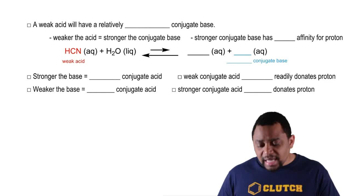
Weak Base and Conjugate Acid

Ammonia (NH3) is a weak base that partially ionizes in water to form ammonium ions (NH4+) and hydroxide ions (OH-). The addition of NH4NO3 introduces NH4+, the conjugate acid of NH3, which affects the equilibrium of the ammonia solution. This relationship is crucial for understanding how the pH changes upon the addition of NH4NO3.
추천 영상:
가이드 코스
01:46
Conjugate Acid-Base Relationships

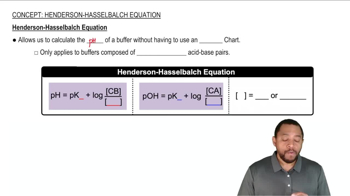
Henderson-Hasselbalch Equation

The Henderson-Hasselbalch equation relates the pH of a buffer solution to the concentration of its acid and base components. For a weak base and its conjugate acid, the equation is pH = pKa + log([base]/[acid]). This equation is particularly useful in calculating the pH after the addition of NH4NO3, as it allows for the quantification of the ratio of NH3 to NH4+ in the solution.
추천 영상:
가이드 코스
02:40
Henderson-Hasselbalch Equation