
Ch.16 Amino Acids, Proteins, and Enzymes
Timberlake - Chemistry: An Introduction to General, Organic, and Biological Chemistry 14th Edition
Timberlake14th EditionChemistry: An Introduction to General, Organic, and Biological ChemistryISBN: 9781292472249당신이 사용하는 게 아니라요?교과서 변경
16장, 문제 50c

In humans, the antibiotic amoxicillin (a type of penicillin) is used to treat certain bacterial infections.
c. Is amoxicillin a reversible or irreversible inhibitor?

검증된 단계별 안내
1
Understand the concept of enzyme inhibitors: Enzyme inhibitors are molecules that bind to enzymes and decrease their activity. They can be classified as reversible or irreversible inhibitors based on how they interact with the enzyme.
Define reversible inhibitors: Reversible inhibitors bind to enzymes non-covalently (e.g., through hydrogen bonds, ionic interactions, or hydrophobic interactions) and can dissociate from the enzyme, allowing the enzyme to regain its activity.
Define irreversible inhibitors: Irreversible inhibitors form covalent bonds with the enzyme, permanently inactivating it. This type of inhibition cannot be reversed, as the enzyme's structure is altered permanently.
Relate the concept to amoxicillin: Amoxicillin is a type of penicillin that inhibits bacterial enzymes called transpeptidases, which are essential for bacterial cell wall synthesis. Amoxicillin forms a covalent bond with the active site of the enzyme, rendering it inactive.
Conclude based on the mechanism: Since amoxicillin forms a covalent bond with the enzyme and permanently inactivates it, it is classified as an irreversible inhibitor.

비슷한 문제에 대한 검증된 영상 답변:

이 영상 해법은 위 문제에 도움이 된다고 튜터들이 추천한 것입니다.
영상 길이:
5m

주요 개념

질문에 올바르게 답하기 위해 반드시 이해해야 하는 핵심 개념들은 다음과 같습니다.

Enzyme Inhibition

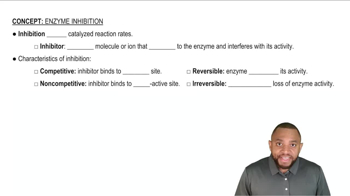
Enzyme inhibition refers to the process by which a molecule (inhibitor) decreases or halts the activity of an enzyme. Inhibitors can be classified as reversible or irreversible, depending on whether their effects can be undone. Understanding this concept is crucial for determining how drugs like amoxicillin interact with bacterial enzymes.
추천 영상:
가이드 코스
1:19
Enzyme Inhibition Concept 1

Reversible Inhibition

Reversible inhibition occurs when an inhibitor binds to an enzyme non-covalently, allowing the enzyme to regain its activity once the inhibitor is removed. This type of inhibition can be competitive, non-competitive, or uncompetitive, and is important for understanding how certain antibiotics function without permanently altering the target enzyme.
추천 영상:
가이드 코스
1:19
Enzyme Inhibition Concept 1

Irreversible Inhibition

Irreversible inhibition involves the permanent binding of an inhibitor to an enzyme, often through covalent bonds, leading to a permanent loss of enzyme activity. This concept is significant in pharmacology, as it helps explain the long-lasting effects of some drugs and their potential side effects on human enzymes.
추천 영상:
가이드 코스
1:19
Enzyme Inhibition Concept 1
관련 실천
교과서 질문

Ethylene glycol (HO—CH2—CH2—OH) is a major component of antifreeze. If ingested, it is first converted to HOOC—CHO (oxoethanoic acid) and then to HOOC—COOH (oxalic acid), which is toxic.

<IMAGE>

a. What class of enzyme catalyzes the reactions described?

1128
views
교과서 질문

Adults who are lactose intolerant cannot break down the disaccharide in milk products. To help digest dairy food, a product known as Lactaid can be given prior to consuming dairy products. (16.4, 16.5)

a. What is the name of enzyme present in Lactaid, and what is the major class of this enzyme?

28
views
교과서 질문

Ethylene glycol (HO—CH2—CH2—OH) is a major component of antifreeze. If ingested, it is first converted to HOOC—CHO (oxoethanoic acid) and then to HOOC—COOH (oxalic acid), which is toxic.

<IMAGE>

b. The treatment for the ingestion of ethylene glycol is an intravenous solution of ethanol. How might this help prevent toxic levels of oxalic acid in the body?

730
views
교과서 질문

In humans, the antibiotic amoxicillin (a type of penicillin) is used to treat certain bacterial infections.

a. Does the antibiotic inhibit enzymes in humans?

746
views
교과서 질문

Oxaloacetate is an inhibitor of succinate dehydrogenase. 

a. Would you expect oxaloacetate to be a competitive or a noncompetitive inhibitor? Why?

696
views
교과서 질문

Methanol and ethanol are oxidized by alcohol dehydrogenase. In methanol poisoning, ethanol is given intravenously to prevent the formation of formaldehyde that has toxic effects.

b. Would ethanol compete for the active site or bind to a different site?

869
views