Ch.16 Amino Acids, Proteins, and Enzymes
Timberlake - Chemistry: An Introduction to General, Organic, and Biological Chemistry 14th Edition
Timberlake14th EditionChemistry: An Introduction to General, Organic, and Biological ChemistryISBN: 9781292472249당신이 사용하는 게 아니라요?교과서 변경
16장, 문제 48a

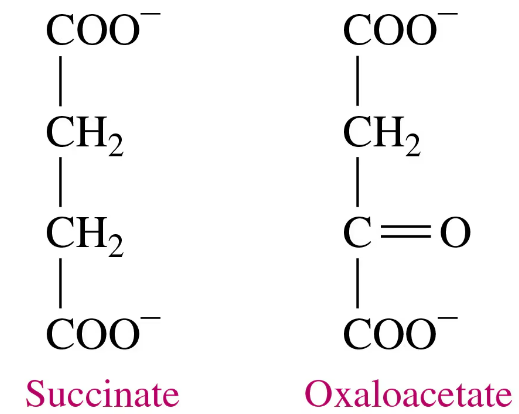
Oxaloacetate is an inhibitor of succinate dehydrogenase. 

a. Would you expect oxaloacetate to be a competitive or a noncompetitive inhibitor? Why?

검증된 단계별 안내
1
Understand the difference between competitive and noncompetitive inhibition: Competitive inhibitors bind to the active site of the enzyme, competing with the substrate, while noncompetitive inhibitors bind to a different site on the enzyme, altering its function without directly competing with the substrate.
Analyze the role of oxaloacetate in the context of succinate dehydrogenase. Oxaloacetate is structurally similar to succinate, the substrate for succinate dehydrogenase, which suggests it may compete for the active site.
Consider the mechanism of inhibition: If oxaloacetate binds to the active site of succinate dehydrogenase, it would prevent succinate from binding, indicating competitive inhibition.
Evaluate whether oxaloacetate could bind elsewhere on the enzyme: If oxaloacetate binds to a site other than the active site and changes the enzyme's shape or function, it would indicate noncompetitive inhibition.
Conclude based on the evidence: Since oxaloacetate is structurally similar to succinate, it is likely a competitive inhibitor, as it competes with succinate for the active site of succinate dehydrogenase.

비슷한 문제에 대한 검증된 영상 답변:

이 영상 해법은 위 문제에 도움이 된다고 튜터들이 추천한 것입니다.
영상 길이:
50s

주요 개념

질문에 올바르게 답하기 위해 반드시 이해해야 하는 핵심 개념들은 다음과 같습니다.

Competitive Inhibition

Competitive inhibition occurs when an inhibitor competes with the substrate for binding to the active site of an enzyme. In this scenario, the presence of the inhibitor can be overcome by increasing the concentration of the substrate. This type of inhibition typically results in an increase in the apparent Km (Michaelis constant) of the enzyme, while Vmax (maximum reaction velocity) remains unchanged.
추천 영상:
가이드 코스
1:19
Enzyme Inhibition Concept 1

Noncompetitive Inhibition

Noncompetitive inhibition happens when an inhibitor binds to an enzyme at a site other than the active site, altering the enzyme's function regardless of substrate concentration. This means that even if the substrate is present, the inhibitor can still prevent the enzyme from catalyzing the reaction effectively. In this case, the Vmax decreases, but the Km remains the same.
추천 영상:
가이드 코스
1:19
Enzyme Inhibition Concept 1

Oxaloacetate's Role

Oxaloacetate is a four-carbon dicarboxylic acid that plays a crucial role in the citric acid cycle. As an inhibitor of succinate dehydrogenase, it can affect the enzyme's activity by either competing with succinate for the active site or binding elsewhere. Understanding its mechanism of inhibition is essential for determining whether it acts as a competitive or noncompetitive inhibitor.
추천 영상:
가이드 코스
0:52
Phase C - Oxaloacetate Regeneration Example 4