 뒤로
뒤로Introduction to Chemistry: Foundational Concepts and Study Guide
스터디 가이드 - 스마트 노트
 자료에 맞춘 맞춤형 노트, 핵심 정의, 예시, 맥락을 확장해 제공합니다.
Introduction to Chemistry
Course Overview and Structure
This course provides a foundational understanding of chemistry, focusing on essential concepts, terminology, and scientific methods. Students will engage with both theoretical and practical aspects, including laboratory work, to develop critical thinking and problem-solving skills in chemistry.
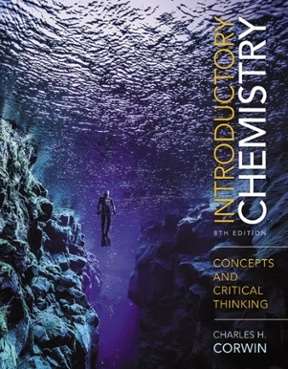
Course Materials: The primary textbook is Introductory Chemistry: Concepts and Critical Thinking by C. H. Corwin (8th edition). Supplementary resources include Schaum’s Outlines, Chemistry for Dummies, and Calculations in Chemistry.
Assessment: Grading is based on exams, homework, participation, lab work, and a comprehensive final exam.
Academic Integrity: Zero tolerance for scholastic dishonesty, including plagiarism and misuse of electronic devices.
Key Study Strategies for Success in Chemistry
Effective Study Habits
Success in chemistry requires consistent effort, organization, and active engagement with the material. The following strategies are recommended:
Begin with clear goals: Set academic targets and plan your study schedule accordingly.
Develop good habits: Study at your most productive time, use a dedicated study space, and take regular breaks (e.g., 50 minutes study, 10 minutes break).
Practice problem-solving: Attempt problems independently before seeking help.
Stay organized: Use folders for notes and summaries, and index cards for definitions and key concepts.
Ask questions: Address unclear topics promptly to avoid falling behind.
Foundational Concepts in Chemistry
Definitions and Language of Chemistry
Chemistry is the study of matter, its properties, and the changes it undergoes. Understanding the language of chemistry is essential for clear communication and comprehension of scientific ideas.
Overview: Chemistry involves the study of substances, their interactions, and the laws governing these processes.
Laws, Hypotheses, and Theories:
Law: A universally accepted explanation of what happens (e.g., Law of Conservation of Mass).
Hypothesis: An educated guess or proposed explanation for a phenomenon.
Theory: A well-tested hypothesis that explains how or why something happens, though it cannot be absolutely proven.
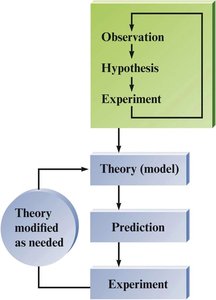
Scientific Method: The systematic approach to investigation in science.
The Scientific Method
The scientific method is a logical process used to investigate natural phenomena and acquire new knowledge.
Observe a phenomenon
Formulate a hypothesis
Design and conduct experiments
Analyze results and refine the hypothesis as needed
Note: Scientific investigations may face limitations such as measurement errors, bias, and reproducibility challenges.
Measurement and the Metric System
Accurate measurement is fundamental in chemistry. The International System of Units (SI) is used for consistency in scientific communication.
SI Base Units:
Mass: kilogram (kg)
Length: meter (m)
Time: second (s)
Temperature: kelvin (K)
Amount of substance: mole (mol)
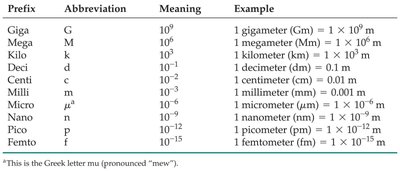
Metric Prefixes: Used to express multiples or fractions of units.
Prefix | Abbreviation | Meaning | Example |
|---|---|---|---|
Giga | G | 109 | 1 gigameter (Gm) = 1 × 10⁹ m |
Mega | M | 106 | 1 megameter (Mm) = 1 × 10⁶ m |
Kilo | k | 103 | 1 kilometer (km) = 1 × 10³ m |
Deci | d | 10-1 | 1 decimeter (dm) = 0.1 m |
Centi | c | 10-2 | 1 centimeter (cm) = 0.01 m |
Milli | m | 10-3 | 1 millimeter (mm) = 0.001 m |
Micro | μ | 10-6 | 1 micrometer (μm) = 1 × 10⁻⁶ m |
Nano | n | 10-9 | 1 nanometer (nm) = 1 × 10⁻⁹ m |
Pico | p | 10-12 | 1 picometer (pm) = 1 × 10-12 m |
Femto | f | 10-15 | 1 femtometer (fm) = 1 × 10-15 m |
The Periodic Table and Chemical Symbols
Structure and Terminology of the Periodic Table
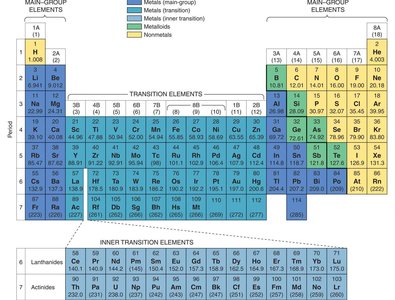
The periodic table organizes elements based on their atomic number, electron configuration, and recurring chemical properties. It is a fundamental tool for understanding chemical behavior.
Groups (Families): Vertical columns; elements in the same group have similar properties.
Periods: Horizontal rows; properties change progressively across a period.
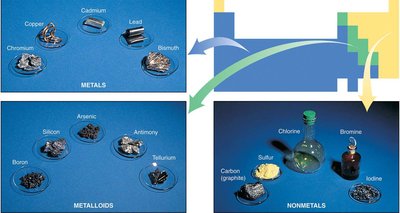
Major Classifications:
Metals
Nonmetals
Metalloids
Special Groups: Alkali metals, alkaline earth metals, chalcogens, halogens, noble gases, transition elements.
Chemical Symbols and Element Names
Chemical elements are represented by international symbols, usually one or two letters (the first capitalized). Some symbols are derived from Latin names (e.g., Na for sodium, Fe for iron).
Memorization: Students should memorize the first 20 elements and several others commonly encountered in chemistry.
Mnemonics: Useful for remembering element order and symbols (e.g., "Happy Henry Likes Beer But Could Not Obtain Food" for H, He, Li, Be, B, C, N, O, F).
Diatomic Molecules
Certain elements naturally exist as diatomic molecules, meaning they are found as pairs of atoms bonded together.
Diatomic Elements: H2, N2, O2, F2, Cl2, Br2, I2
Classification of Compounds
Chemical compounds are classified based on the types of elements they contain and the nature of their bonds.
Ionic Compounds: Composed of metals and nonmetals; involve transfer of electrons.
Molecular (Covalent) Compounds: Composed of nonmetals; involve sharing of electrons.
Nature of Science and Chemistry in Everyday Life
What is Science?
Science is the systematic study of nature, aiming to understand how and why things work through logic and experimentation. It is essential to qualify statements and base conclusions on evidence.
Chemicals in Daily Life
Everything we see, smell, taste, or touch is composed of chemicals. Not all chemicals are hazardous; context and risk assessment are important in evaluating their effects.
Examples:
NaCl (table salt): Essential for nerve conduction but can contribute to high blood pressure.
CH3COOH (acetic acid): Used in vinegar and pickling.
C12H22O11 (sucrose): Common sugar.
Risk Assessment: The benefits and risks of chemicals (e.g., medicines) must be carefully weighed.
Sample Questions for Review
A chemical theory that has been known for a long time becomes a law. (True/False)
Which of the following are incorrectly paired?
A) K, alkali metal
B) Ba, alkaline earth metal
C) O, halogen
D) Ne, noble gas
E) Ni, transition metal
A certain sample of a pure substance was heated in the open atmosphere and a white solid weighing 14% more than the original sample resulted. Is the product an element or a compound?
Weekly Tasks and Course Engagement
Read and understand the syllabus; submit the syllabus signature.
Access and familiarize yourself with the Canvas and Pearson sites for course materials and assignments.
Work through lecture slides and complete assigned homework.
Ask questions whenever clarification is needed.
