Euler Paths and Euler Circuits: 동영상 및 연습문제
Euler Paths and Euler Circuits focus on tracing a graph by following its edges under a strict rule: each edge must be used exactly once. An Euler path is a path that travels along every edge exactly once, while an Euler circuit is a circuit that also uses every edge exactly once.
To classify a given sequence of vertices, trace the route from one vertex to the next and check whether every edge in the graph is included exactly one time. If the route starts and ends at different vertices but still covers each edge exactly once, it is an Euler path. If it starts and ends at the same vertex and covers each edge exactly once, it is an Euler circuit.
If any edge is missed, repeated, or the route does not match the required path or circuit structure, the sequence is neither. The key idea is to distinguish between open and closed tracing while making sure the entire graph’s edge set is covered exactly once.
Euler Paths and Euler Circuits


Using the graph below, determine if the sequence of vertices describes an Euler path (E.P.), an Euler circuit (E.C.), or neither.
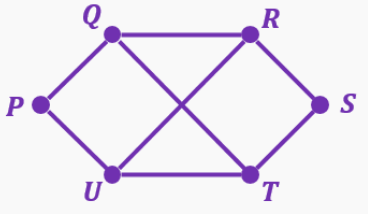
E.P.
E.C.
NEITHER
Using the graph below, determine if the sequence of vertices describes an Euler path (E.P.), an Euler circuit (E.C.), or neither.
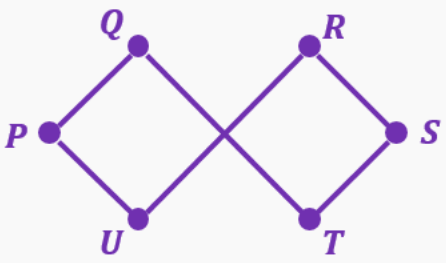
E.P.
E.C.
NEITHER
Using the graph below, determine if the sequence of vertices describes an Euler path (E.P.), an Euler circuit (E.C.), or neither.
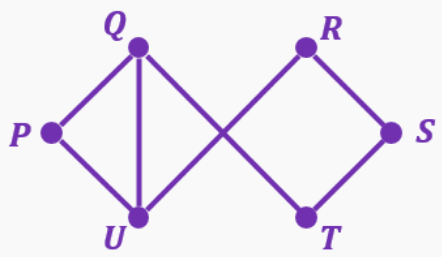
E.P.
E.C.
NEITHER
Euler Paths and Euler Circuits Example 1
Euler Paths and Euler Circuits Example 2
Euler Paths and Euler Circuits Example 3
학생들이 이 주제에 대해 묻는 질문은 다음과 같습니다:
An Euler path is a route through a graph that uses every edge exactly once but starts and ends at different vertices. In contrast, an Euler circuit is a special type of Euler path that starts and ends at the same vertex, also covering every edge exactly once. The key difference lies in whether the path is open (Euler path) or closed (Euler circuit). Both concepts require that no edge is missed or repeated, ensuring the entire graph's edges are traced exactly once.
To determine if a graph has an Euler path or circuit, examine the degrees of its vertices. A graph has an Euler circuit if every vertex has an even degree (an even number of edges connected). It has an Euler path but not a circuit if exactly two vertices have an odd degree, and all others are even. If more than two vertices have an odd degree, the graph has neither an Euler path nor an Euler circuit. This classification helps in understanding whether a route covering all edges exactly once is possible.
Using each edge exactly once in Euler paths and circuits is crucial because the concept focuses on tracing the entire graph without repetition or omission of edges. This ensures a complete traversal of the graph's structure, which is essential in applications like network routing, puzzle solving, and circuit design. Repeating or missing edges would violate the definition and purpose of Euler paths and circuits, making the route invalid.
Yes, an Euler path that starts and ends at the same vertex is called an Euler circuit. This is a closed path that covers every edge of the graph exactly once. The Euler circuit is a special case of an Euler path where the route forms a loop, returning to the starting point after traversing all edges without repetition.
To classify a sequence of vertices, trace the route from one vertex to the next and check if every edge is used exactly once. If the route covers all edges without repetition and starts and ends at different vertices, it is an Euler path. If it starts and ends at the same vertex, it is an Euler circuit. If any edge is missed, repeated, or the route does not fit these conditions, the sequence is neither. This method ensures the route meets the strict criteria of Euler paths and circuits.