Paths and Circuits: 동영상 및 연습문제
Paths and Circuits in a graph focus on moving through a sequence of vertices by following exactly one connecting edge at each step. A sequence is a path when each consecutive pair of vertices is connected by a single unique edge. If any step cannot be made along one edge, the sequence is neither. The length of a path is the number of edges used along that path.
A circuit is a sequence that also travels from vertex to vertex along single unique edges, but it begins and ends at the same vertex. A path begins and ends at different vertices, while a circuit returns to its starting point. Graphs may also include a loop, which is an edge that starts and ends at the same vertex, and that loop can be part of a path or circuit when it matches the given sequence. Understanding how to trace the sequence and identify which edges are included or excluded is central to classifying paths and circuits correctly.
Paths and Circuits


Using the graph below, determine which edges are NOT part of the path .
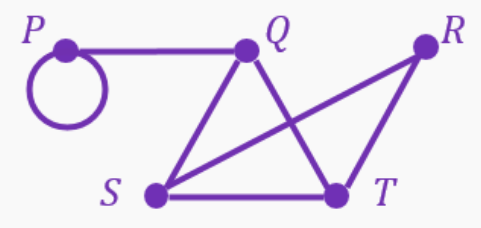
Loop at vertex P, QT, QS
Loop at vertex P, QT, RS
QS, ST, TR
PQ, RS, TR
What is the length of the path ?
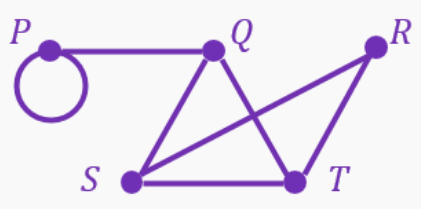
5
3
4
6
Referring to the graph below, determine if each sequence of vertices is a path, circuit, or neither.
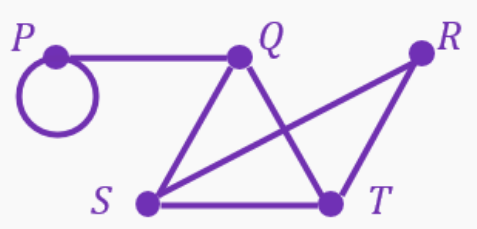
PATH
CIRCUIT
NEITHER
Referring to the graph below, determine if each sequence of vertices is a path, circuit, or neither.
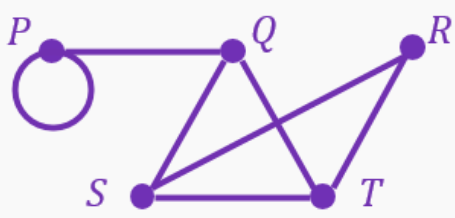
PATH
CIRCUIT
NEITHER
Referring to the graph below, determine if each sequence of vertices is a path, circuit, or neither.
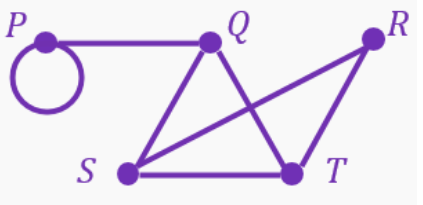
PATH
CIRCUIT
NEITHER
Paths and Circuits Example 1
Paths and Circuits Example 2
학생들이 이 주제에 대해 묻는 질문은 다음과 같습니다:
In graph theory, a path is a sequence of vertices where each consecutive pair is connected by a unique edge, and it starts and ends at different vertices. The length of a path is the number of edges it contains. On the other hand, a circuit is a special type of path that starts and ends at the same vertex, forming a closed loop. While paths do not revisit the starting vertex, circuits do, making circuits useful for analyzing cycles within graphs. Understanding these differences is essential for classifying sequences in graphs and solving problems related to traversal and connectivity.
A loop in a graph is an edge that starts and ends at the same vertex. Loops can be part of both paths and circuits if they fit the sequence of vertices being considered. For example, a loop can be included in a circuit since circuits start and end at the same vertex, and the loop represents an edge that connects the vertex to itself. However, when considering paths, loops are only included if the sequence explicitly requires revisiting the same vertex via that loop. Loops add complexity to graph traversal because they allow repeated visits to a vertex without moving to a different vertex.
The length of a path or circuit in a graph is determined by counting the number of edges used in the sequence. Each edge represents a step from one vertex to another. For example, if a path goes through vertices to to , and there are edges connecting to and to , the length is 2. This count helps in analyzing the shortest or longest paths and circuits within a graph.
For a sequence of vertices to be considered a path, each consecutive pair of vertices must be connected by exactly one unique edge. This means you can move from one vertex to the next without ambiguity or multiple edges between the same pair. Additionally, the path must not revisit the same vertex unless explicitly allowed, and it must start and end at different vertices. If any step in the sequence cannot be made along a single edge, the sequence is not a path. This ensures the path represents a clear, unambiguous route through the graph.
To identify if a sequence of vertices forms a circuit, check that the sequence starts and ends at the same vertex and that each consecutive pair of vertices is connected by a unique edge. The circuit must form a closed loop, meaning the last vertex in the sequence is the same as the first. Additionally, the edges used must be distinct and follow the order of vertices in the sequence. If these conditions are met, the sequence is a circuit, which is useful for analyzing cycles and loops within the graph.