뒤로
Adaptive Immunity: Specific Defenses of the Host – Study Notes
스터디 가이드 - 스마트 노트
 자료에 맞춘 맞춤형 노트, 핵심 정의, 예시, 맥락을 확장해 제공합니다.
Adaptive Immunity: Specific Defenses of the Host
Overview of Adaptive Immunity
Adaptive immunity is a highly specific defense mechanism that targets particular pathogens. It is acquired through infection or vaccination and is characterized by a primary response (first exposure) and a secondary response (subsequent exposures), which is faster and more effective due to immunological memory.
Primary response: Initial encounter with a foreign substance.
Secondary response: Subsequent encounters, enhanced by memory cells.
Comparison of Adaptive and Innate Immunity
Adaptive immunity differs from innate immunity in specificity and memory. While innate immunity provides immediate, non-specific defense, adaptive immunity is slower but highly specific and capable of remembering past pathogens.
Innate immunity: Non-specific, immediate response.
Adaptive immunity: Specific, delayed response with memory.
Dual Nature of the Adaptive Immune System
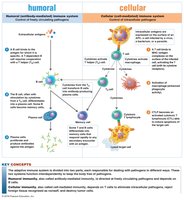
The adaptive immune system consists of two main branches: humoral and cellular immunity.
Humoral immunity: Mediated by B cells and antibodies; combats extracellular pathogens such as bacteria and toxins.
Cellular immunity: Mediated by T cells; targets intracellular pathogens like viruses, some fungi, and parasites.
Humoral Immunity
B cells are lymphocytes that mature in the red bone marrow. They recognize antigens and produce antibodies, which are effective against invaders outside cells.
B cells: Recognize antigens, produce antibodies.
Antibodies: Bind to antigens and neutralize or eliminate them.
Cellular Immunity
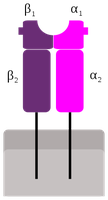
T cells mature in the thymus and recognize antigenic peptides processed by phagocytic cells. T cell receptors (TCRs) interact with antigens, leading to cytokine secretion.
T cells: Recognize processed antigens, secrete cytokines.
NK cells: Natural killer cells, attack without prior activation.
TH cells: Express CD4+; TC cells: Express CD8+.
Differentiation of T Cells and B Cells
Stem cells in bone marrow or fetal liver differentiate into B cells (in bone marrow) and T cells (in thymus). These cells migrate to lymphoid tissues such as the spleen and lymph nodes.
Cytokines: Chemical Messengers of Immune Cells
Cytokines are signaling molecules produced in response to stimuli, facilitating communication between immune cells.
Interleukins: Communication between leukocytes.
Chemokines: Induce migration of leukocytes.
Interferons (IFNs): Interfere with viral infections.
Tumor necrosis factor (TNF): Involved in inflammation.
Hematopoietic cytokines: Control development of blood cells.
Cytokine storm: Overproduction of cytokines, potentially harmful.
Antigens and Antibodies
Antigens, Epitopes, and Haptens
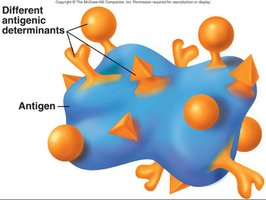
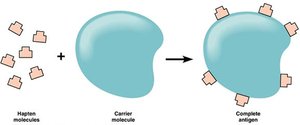
Antigens are substances that provoke an immune response, typically components of microbes or foreign substances. Antibodies interact with specific regions called epitopes (antigenic determinants). Haptens are small molecules that become antigenic only when attached to carrier molecules.
Antigen: Substance that induces antibody production.
Epitope: Specific region of an antigen recognized by antibodies.
Hapten: Small molecule, antigenic only when attached to a carrier.
Antibody Structure and Function
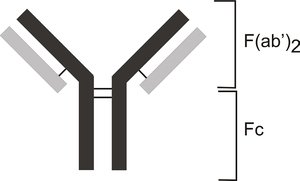
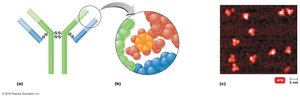
Antibodies, or immunoglobulins (Ig), are Y-shaped globular proteins composed of two identical light chains and two identical heavy chains joined by disulfide bonds. The variable (V) regions at the ends of the arms bind epitopes, while the constant (Fc) region forms the stem. Antibodies are classified into five types: IgG, IgM, IgA, IgD, and IgE.
Valence: Number of antigen-binding sites (bivalent = 2 sites).
Variable region: Binds to epitopes.
Constant region: Identical for each antibody class.
Immunoglobulin Classes
Immunoglobulins are divided into five classes, each with distinct functions and valence.
Class | Valence | Main Function |
|---|---|---|
IgG | 2 | Most abundant; crosses placenta; protects against bacteria and viruses |
IgM | 10 | First antibody produced; effective in agglutination |
IgA | 4 | Found in mucosal areas; protects body surfaces |
IgD | 2 | Functions mainly as a B cell receptor |
IgE | 2 | Involved in allergic responses and defense against parasites |
Antigen–Antibody Binding and Its Results
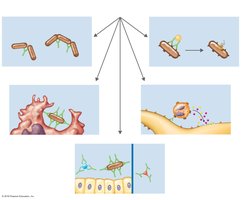
When antibodies bind to antigens, they form antigen–antibody complexes, which protect the host by tagging foreign molecules for destruction. The outcomes include agglutination, opsonization, antibody-dependent cell-mediated cytotoxicity, neutralization, and activation of the complement system.
Agglutination: Clumping of antigens.
Opsonization: Coating antigens to enhance phagocytosis.
Antibody-dependent cell-mediated cytotoxicity: Destruction by immune cells.
Neutralization: Blocking pathogen attachment.
Complement activation: Causes inflammation and cell lysis.
Humoral Immunity Response Process
T-Dependent and T-Independent Antigens
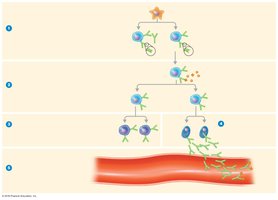
T-dependent antigens require the assistance of T helper cells for B cell activation, while T-independent antigens can activate B cells directly. Plasma cells are differentiated B cells that produce antibodies, whereas memory cells provide long-term immunity.
T-dependent antigens: Require T helper cell involvement.
T-independent antigens: Activate B cells without T cell help.
Plasma cell: Antibody-producing cell.
Memory cell: Long-lived cell for rapid secondary response.
Clonal Selection and Differentiation
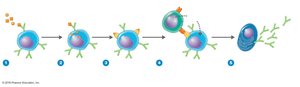
Clonal selection is the process by which B cells that recognize a specific antigen proliferate and differentiate into plasma cells and memory cells. Major histocompatibility complex (MHC) molecules present antigen fragments to T cells, facilitating activation.
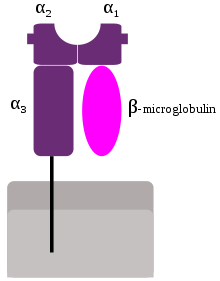
MHC class I: Present on all nucleated cells; identify self.
MHC class II: Present on antigen-presenting cells (APCs).
Cellular Immunity Response Process
Antigen-Presenting Cells (APCs)
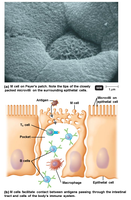
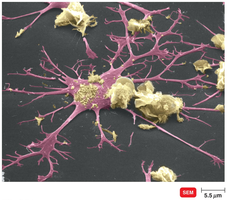
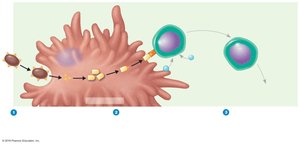
APCs such as dendritic cells and macrophages engulf and process antigens, presenting them to T cells. Dendritic cells are found in various tissues, while macrophages are activated by cytokines or antigen ingestion.
Dendritic cells: Display antigens to T cells.
Macrophages: Present antigens and migrate to lymph tissue.
Classes of T Cells
T cells are classified by clusters of differentiation (CD) markers:
CD4+ (T helper cells, TH): Interact with MHC class II molecules.
CD8+ (Cytotoxic T lymphocytes, CTL): Interact with MHC class I molecules.
T regulatory cells (Treg): Suppress immune responses against self.
T Helper Cell Activation and Differentiation
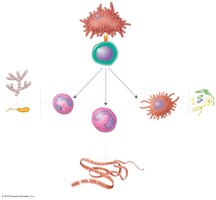
T helper cells (CD4+) recognize antigen fragments presented by APCs with MHC class II molecules. Upon activation, they differentiate into TH1, TH2, TH17, and memory cells, each with distinct functions.
TH1 cells: Activate macrophages, enhance complement, stimulate antibody production.
TH2 cells: Activate B cells to produce IgE, activate eosinophils.
TH17 cells: Produce IL-17, promote inflammation.
T Regulatory Cells
T regulatory cells (Treg) are a subset of CD4+ cells carrying CD25. They suppress T cells against self, protect intestinal bacteria, and safeguard the fetus during pregnancy.
T Cytotoxic Cells (CD8+ T Cells)
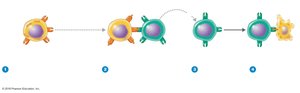
Activated cytotoxic T lymphocytes (CTLs) recognize and kill infected self-cells presenting endogenous antigens with MHC class I molecules. CTLs release perforin and granzymes, inducing apoptosis in target cells.
Apoptosis: Programmed cell death, prevents spread of infection.
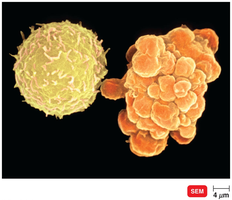
Principal Cells in Cell-Mediated Immunity
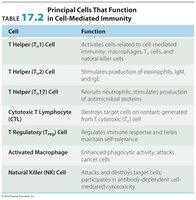
Various cells participate in cell-mediated immunity, each with specific functions.
Cell | Function |
|---|---|
T Helper (TH1) | Activates cells related to cell-mediated immunity |
T Helper (TH2) | Stimulates production of eosinophils, IgM, and IgE |
T Helper (TH17) | Recruits neutrophils, stimulates production of antimicrobial proteins |
Cytotoxic T Lymphocyte (CTL) | Destroys target cells on contact |
T Regulatory (Treg) | Regulates immune response, maintains self-tolerance |
Activated Macrophage | Enhances phagocytic activity |
Natural Killer (NK) | Attacks and destroys target cells |
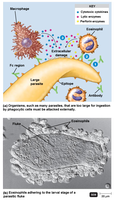
Natural Killer (NK) Cells
NK cells are granular leukocytes that destroy cells lacking MHC class I self-antigens. They kill virus-infected and tumor cells, and attack parasites by forming pores in target cells, leading to lysis or apoptosis.
Immunological Memory
Primary vs. Secondary Immune Response
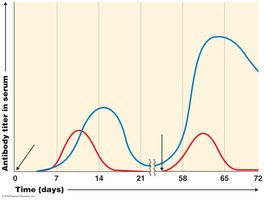
The secondary (memory) response is more rapid, lasts longer, and is greater in magnitude than the primary response. Memory cells produced during the initial exposure are activated upon subsequent exposures. Antibody titer reflects the intensity of the humoral response, with IgM produced first, followed by IgG.
Types of Adaptive Immunity
Four Types of Adaptive Immunity
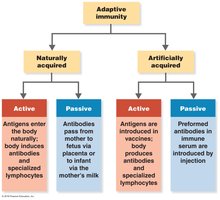
Adaptive immunity can be acquired naturally or artificially, and can be active or passive.
Naturally acquired active immunity: Resulting from infection.
Naturally acquired passive immunity: Transplacental or via colostrum.
Artificially acquired active immunity: Injection of vaccination.
Artificially acquired passive immunity: Injection of antibodies.