뒤로
뒤로Prokaryotic Cell Structures & Functions: Microbiology Study Guide
스터디 가이드 - 스마트 노트
 자료에 맞춘 맞춤형 노트, 핵심 정의, 예시, 맥락을 확장해 제공합니다.
Prokaryotic & Eukaryotic Cells
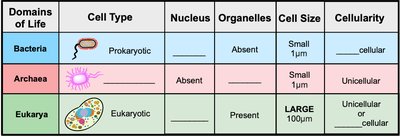
Domains of Life and Cell Types
All living organisms are classified into three domains: Bacteria, Archaea, and Eukarya. These domains are distinguished by their cell type, presence of nucleus and organelles, cell size, and cellularity.
Bacteria: Prokaryotic, no nucleus, no organelles, small (1 μm), usually unicellular.
Archaea: Prokaryotic, no nucleus, no organelles, small (1 μm), unicellular.
Eukarya: Eukaryotic, nucleus present, organelles present, large (100 μm), unicellular or multicellular.
Prokaryotic Cell Features
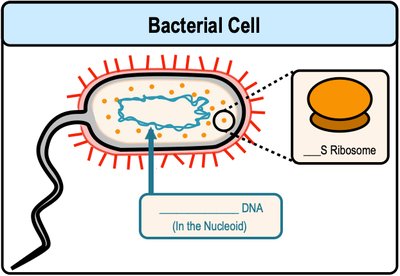
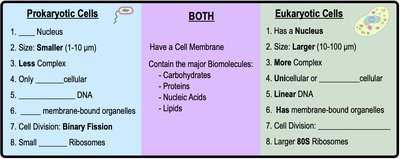
Prokaryotic cells lack a nucleus and membrane-bound organelles. Their DNA is circular and located in a region called the nucleoid. They possess small (70S) ribosomes and reproduce by binary fission.
Nucleoid: Region where circular DNA is found.
Ribosomes: Small, 70S type, site of protein synthesis.
Binary Fission: Asexual reproduction method.
Eukaryotic Cell Features
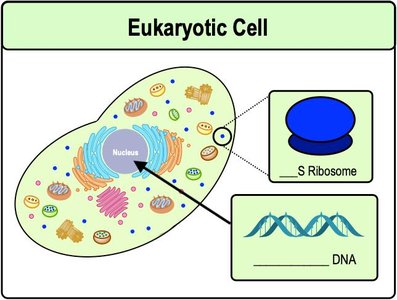
Eukaryotic cells have a nucleus and various membrane-bound organelles. Their DNA is linear and contained within the nucleus. They possess large (80S) ribosomes and divide by mitosis and cytokinesis.
Nucleus: Membrane-bound organelle containing DNA.
Ribosomes: Large, 80S type.
Cell Division: Mitosis and cytokinesis.
Comparison: Prokaryotic vs. Eukaryotic Cells
Key differences exist between prokaryotic and eukaryotic cells, including size, complexity, DNA structure, and cell division mechanisms.
Prokaryotes: No nucleus, smaller size, less complex, only unicellular, circular DNA, binary fission, small ribosomes.
Eukaryotes: Nucleus present, larger size, more complex, can be unicellular or multicellular, linear DNA, mitosis, large ribosomes.
Both: Have a cell membrane and contain major biomolecules (carbohydrates, proteins, nucleic acids, lipids).
Binary Fission in Prokaryotes
Overview of Binary Fission
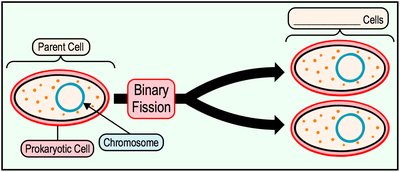
Binary fission is the primary method of reproduction in prokaryotes. It is an asexual process where one cell divides to form two identical daughter cells.
Parent Cell: Original cell before division.
Daughter Cells: Two identical cells formed after division.
Steps of Binary Fission
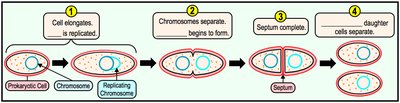
Binary fission occurs in a series of steps:
Cell elongates and replicates its chromosome.
Chromosomes separate and a septum begins to form.
Septum completes, creating two connected cells.
Cells fully separate into two identical daughter cells.
Generation Time and Microbial Growth
Generation Time
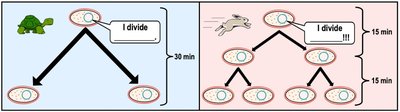
Generation time is the period required for a cell to undergo binary fission and produce a new generation. Different microbes have varying generation times, affecting their growth rates.
Doubling Time: Time it takes for a population to double in number.
Equation: Where = final number of cells, = initial number of cells, = number of generations ().
Bacterial Cell Morphology & Arrangements
Cell Morphology
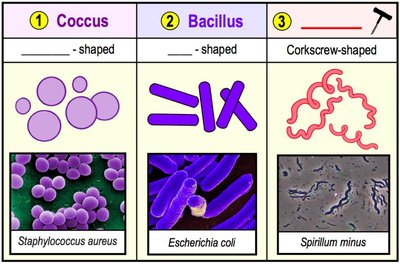
Bacterial cell morphology refers to the shape of individual cells. Common shapes include coccus (spherical), bacillus (rod-shaped), and spiral (corkscrew-shaped).
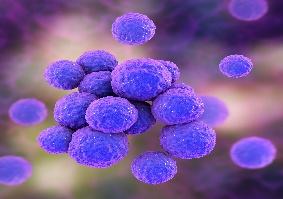
Coccus: Spherical shape.
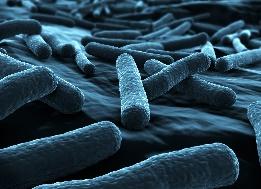
Bacillus: Rod shape.
Spirillum/Spiral: Corkscrew or spiral shape.
Cocci Arrangements
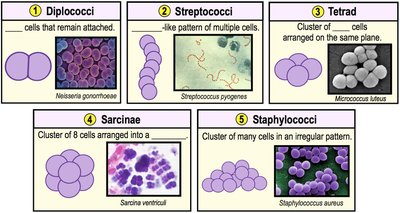
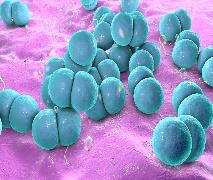
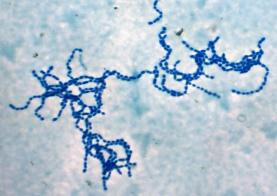
Cocci can be arranged in various patterns after cell division:
Diplococci: Pairs of cells.
Streptococci: Chains of cells.
Tetrad: Clusters of four cells.
Sarcinae: Clusters of eight cells in a cube.
Staphylococci: Irregular clusters.
Bacilli Arrangements
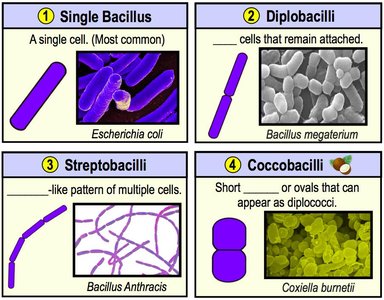
Bacilli can be arranged as single cells, pairs (diplobacilli), chains (streptobacilli), or short/oval cells (coccobacilli).
Single Bacillus: Individual rod-shaped cell.
Diplobacilli: Pairs of rod-shaped cells.
Streptobacilli: Chains of rod-shaped cells.
Coccobacilli: Short rods or ovals.
Spiral-Shaped Bacterial Cells
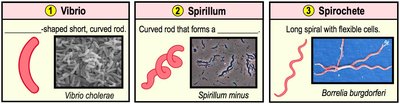
Spiral-shaped bacteria include vibrio (curved rod), spirillum (rigid spiral), and spirochete (flexible spiral).
Vibrio: Comma-shaped, short curved rod.
Spirillum: Rigid spiral.
Spirochete: Flexible spiral.
Overview of Prokaryotic Cell Structures
Structural Components
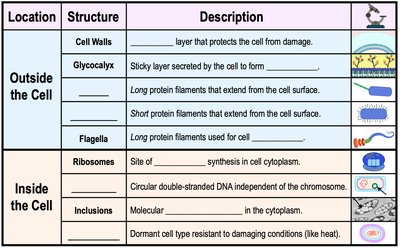
Prokaryotic cells have various structural components both outside and inside the cell.
Location | Structure | Description |
|---|---|---|
Outside | Cell Wall | Semi-rigid layer that protects the cell from damage. |
Outside | Glycocalyx | Sticky layer secreted by the cell to form capsules or slime layers. |
Outside | Flagella | Long protein filaments used for cell motility. |
Outside | Pili/Fimbriae | Short protein filaments that extend from the cell surface for attachment or DNA transfer. |
Inside | Ribosomes | Site of protein synthesis in cell cytoplasm. |
Inside | Plasmids | Circular double-stranded DNA independent of the chromosome. |
Inside | Inclusions | Molecular aggregates in the cytoplasm. |
Inside | Endospores | Dormant cell type resistant to damaging conditions. |
Bacterial Cell Walls and Peptidoglycan
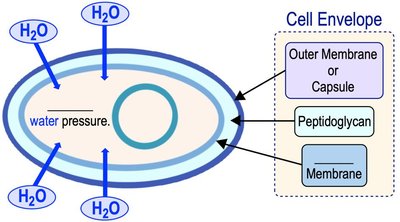
Cell Envelope and Water Pressure
Bacterial cells experience high internal water pressure, requiring a protective cell wall. The cell envelope includes the cell wall, cell membrane, and, if present, an outer membrane or capsule.