 뒤로
뒤로Recombinant DNA Technology: Tools, Techniques, and Applications
스터디 가이드 - 스마트 노트
 자료에 맞춘 맞춤형 노트, 핵심 정의, 예시, 맥락을 확장해 제공합니다.
Recombinant DNA Technology
Overview and Goals
Recombinant DNA technology is a cornerstone of modern biotechnology, involving the intentional modification of genomes for practical purposes. The main goals are to eliminate undesirable traits, combine beneficial traits, and create organisms capable of synthesizing products needed by humans.
Biotechnology: The use of microorganisms to produce practical products.
Recombinant DNA technology: Modifying genomes for specific purposes.
Goals:
Eliminate undesirable phenotypic traits
Combine beneficial traits from multiple organisms
Create organisms that synthesize useful products
Tools of Recombinant DNA Technology
Mutagens
Mutagens are agents that cause changes in DNA, increasing genetic diversity and enabling the selection of desirable traits for further manipulation.
Mutagens: Chemicals or radiation that induce mutations in DNA.
Reverse Transcriptase and cDNA
Reverse transcriptase, isolated from retroviruses, synthesizes complementary DNA (cDNA) from an RNA template. This process is crucial for cloning eukaryotic genes in prokaryotes, as cDNA lacks introns.
Reverse transcriptase: Enzyme that transcribes RNA into cDNA.
cDNA: DNA generated from mRNA, with introns removed.
Application: Allows expression of eukaryotic genes in prokaryotic cells.
Synthetic Nucleic Acids
Synthetic nucleic acids are artificially produced DNA and RNA molecules used for various purposes, including elucidating the genetic code, creating genes, and designing probes and primers.
Uses:
Genetic code elucidation
Gene creation for specific proteins
DNA/RNA probes for sequence identification
Antisense nucleic acids
PCR primers
Restriction Enzymes
Restriction enzymes are bacterial proteins that cut DNA at specific sequences called restriction sites, which are often palindromic. They are categorized by the type of cut they produce: sticky ends or blunt ends.
Sticky ends: Overhanging sequences that facilitate ligation.
Blunt ends: Straight cuts with no overhang.
Vectors
Vectors are nucleic acid molecules used to deliver genes into cells. They must be small, survive inside cells, contain genetic markers, and ensure gene expression. Common vectors include plasmids, viral genomes, and transposons.
Properties:
Manipulable size
Cell survival
Genetic markers
Gene expression assurance
CRISPR-Cas System
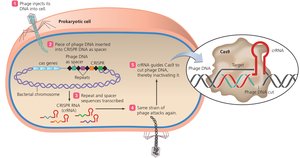
CRISPR (Clustered, Regularly Interspaced, Short Palindromic Repeats) is a primitive immune system in prokaryotes, protecting against viral infection. Cas enzymes can be used to edit DNA, inactivate, or replace target genes, offering potential for treating genetic diseases.
CRISPR: Repeats interspersed with spacers derived from viral DNA.
Cas enzymes: Proteins that cut DNA at targeted sites.
Applications: Gene editing, disease treatment.
Gene Libraries
Gene libraries are collections of bacterial or phage clones, each containing a gene from an organism's genome. Libraries may represent all genes from a chromosome or a set of cDNA complementary to mRNA.
Gene library: Repository of cloned genes for research and manipulation.
Techniques of Recombinant DNA Technology
Polymerase Chain Reaction (PCR)
PCR is a technique for amplifying DNA in vitro, producing large numbers of identical DNA molecules. It is essential for diagnostics, research, and epidemiology. The process involves denaturation, priming, and extension, and is automated using a thermocycler.
Steps:
Denaturation: Heating to 94°C to separate DNA strands.
Priming: Cooling to 65°C and adding primers.
Extension: DNA polymerase synthesizes new strands at 72°C.
Example: Used to distinguish Ebola outbreaks in Africa (2014).
Equation:
Gel Electrophoresis and Southern Blot
Gel electrophoresis separates DNA molecules based on charge, size, and shape. DNA is drawn toward a positive electrode through an agarose gel, with smaller fragments migrating faster. The Southern blot technique allows for the identification of specific DNA sequences.
Gel electrophoresis: Separation and isolation of DNA fragments.
Southern blot: Transfer and detection of DNA sequences.
DNA Microarrays
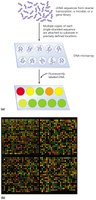
DNA microarrays consist of immobilized single-stranded DNA molecules. Fluorescently labeled DNA adheres to complementary sequences, enabling monitoring of gene expression, infection diagnosis, and organism identification in environmental samples.
Applications:
Gene expression monitoring
Infection diagnosis
Environmental organism identification
Inserting DNA into Cells
The goal of recombinant DNA technology is to insert DNA into cells. This can be achieved through natural methods (transformation, transduction, conjugation) or artificial methods (electroporation, protoplast fusion, gene gun, microinjection, heat shock).
Natural methods: Transformation, transduction, conjugation.
Artificial methods: Electroporation, protoplast fusion, injection, heat shock.
Applications of Recombinant DNA Technology
Genetic Mapping
Genetic mapping locates genes on nucleic acid molecules, providing insights into metabolism, growth, and relatedness. Early techniques include restriction fragmentation and fluorescent in situ hybridization (FISH).
Genomics: Sequencing and analysis of genomes.
Next-generation sequencing: Rapid, comprehensive genome analysis.
Microbial Community Studies
Most microorganisms are known only by their DNA fingerprints, as they have not been cultured. Next-generation sequencing enables identification of all members of a microbiome, such as the 500+ species found in the human mouth.
Microbiome: All microorganisms in a particular environment.
Pharmaceutical and Therapeutic Applications
Recombinant DNA technology is used for protein synthesis, vaccine production, genetic screening, gene therapy, medical diagnosis, xenotransplants, and biomedical animal models.
Protein synthesis: Bacteria and yeast produce synthetic proteins.
Vaccines: Safer, subunit vaccines; genes introduced into plants or injected into humans.
Genetic screening: DNA microarrays identify inherited diseases and viral DNA.
Gene therapy: Replacement of defective genes with normal copies.
Medical diagnosis: Detection of pathogen-specific gene sequences.
Xenotransplants: Animal tissues/organs used in humans.
Biomedical animal models: Animals used to study diseases and develop treatments.
Agricultural Applications
Transgenic organisms (GMOs) are produced by adding genes from other organisms. Applications include herbicide tolerance, salt tolerance, freeze resistance, and pest resistance.
Herbicide tolerance: Gene from Agrobacterium tumefaciens confers resistance to glyphosate.
Salt tolerance: Genes inserted into tomato and canola plants.
Freeze resistance: Genetically modified bacteria sprayed on crops.
Pest resistance: Bacillus thuringiensis (Bt) toxin gene inserted into crops.
Phytophthora resistance: Genes inserted into potato crops.
Ethics and Safety of Recombinant DNA Technology
Potential Risks and Concerns
Long-term effects of transgenic manipulations are unknown. Natural genetic transfer could spread genes to other organisms, potentially triggering allergies or pathogenicity. Standards are imposed on labs to ensure safety, but the technology could be used to create biological weapons.
Risks: Allergies, pathogenicity, environmental impact.
Safety: Laboratory standards, risk assessments.
Ethical Issues
Ethical concerns include routine screenings, payment responsibility, genetic privacy, profits from altered organisms, required screening, and forced correction of genetic abnormalities.
Genetic privacy: Who has access to genetic information?
Screening: Should it be mandatory?
Correction: Should genetic abnormalities be forcibly corrected?
Additional info: Ethical debates continue as technology advances, requiring careful consideration of societal, legal, and medical implications.
