Ch. 18 - Reactions of Benzene and Substituted Benzenes
Bruice - Organic Chemistry 8th Edition
Bruice8th EditionOrganic ChemistryISBN: 9780135213711당신이 사용하는 게 아니라요?교과서 변경
18장, 문제 67b

b. Rank the same esters from most reactive to least reactive in the second slow step of a nucleophilic acyl substitution reaction (collapse of the tetrahedral intermediate).

검증된 단계별 안내
1
Step 1: Understand the context of nucleophilic acyl substitution. The second slow step involves the collapse of the tetrahedral intermediate, where the leaving group departs and the carbonyl group reforms. The reactivity depends on the stability of the leaving group and the electronic effects of substituents on the ester.
Step 2: Analyze the substituents attached to the aromatic ring or alkyl group in each ester. Electron-withdrawing groups (EWGs) stabilize the negative charge on the leaving group, making the collapse of the tetrahedral intermediate faster. For example, chlorine atoms are strong EWGs.
Step 3: Compare the esters: (A) has a single chlorine substituent on the aromatic ring, (B) has no aromatic ring and is an alkyl ester, (C) has an unsubstituted aromatic ring, and (D) has two chlorine substituents on the aromatic ring. The presence of EWGs (like chlorine) on the aromatic ring increases reactivity.
Step 4: Rank the esters based on the number and position of EWGs. Ester D, with two chlorine substituents, is the most reactive due to the strong electron-withdrawing effect. Ester A, with one chlorine substituent, is next. Ester C, with an unsubstituted aromatic ring, follows. Ester B, an alkyl ester, is the least reactive as it lacks EWGs.
Step 5: Conclude the ranking: D > A > C > B. This ranking is based on the electronic effects of substituents influencing the stability of the leaving group during the collapse of the tetrahedral intermediate.

비슷한 문제에 대한 검증된 영상 답변:

이 영상 해법은 위 문제에 도움이 된다고 튜터들이 추천한 것입니다.
영상 길이:
9m

주요 개념

질문에 올바르게 답하기 위해 반드시 이해해야 하는 핵심 개념들은 다음과 같습니다.

Nucleophilic Acyl Substitution

Nucleophilic acyl substitution is a fundamental reaction in organic chemistry where a nucleophile attacks the carbonyl carbon of an acyl compound, leading to the formation of a tetrahedral intermediate. This intermediate can collapse, resulting in the substitution of the leaving group (often an alcohol or halide) with the nucleophile. Understanding this mechanism is crucial for predicting the reactivity of different acyl compounds, such as esters.
추천 영상:
01:47
Nucleophiles and Electrophiles can react in Substitution Reactions.

Reactivity of Esters

The reactivity of esters in nucleophilic acyl substitution is influenced by the nature of the substituents attached to the carbonyl carbon. Electron-withdrawing groups, such as halogens, increase the electrophilicity of the carbonyl carbon, making the ester more reactive. Conversely, electron-donating groups can decrease reactivity. Thus, analyzing the substituents on the esters in the question is essential for ranking their reactivity.
추천 영상:
02:39
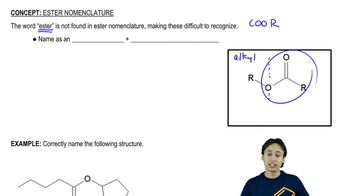
Ester Nomenclature

Tetrahedral Intermediate Stability

The stability of the tetrahedral intermediate formed during nucleophilic acyl substitution plays a significant role in determining the overall reaction rate. Factors such as steric hindrance and electronic effects from substituents can affect the stability of this intermediate. A more stable intermediate will lead to a slower collapse and thus a slower reaction, while an unstable intermediate will collapse more readily, indicating higher reactivity.
추천 영상:
04:31
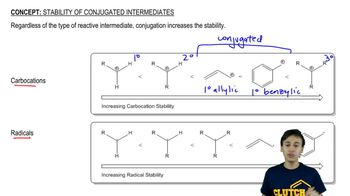
Stability of Conjugated Intermediates