Ch. 18 - Reactions of Benzene and Substituted Benzenes
Bruice - Organic Chemistry 8th Edition
Bruice8th EditionOrganic ChemistryISBN: 9780135213711당신이 사용하는 게 아니라요?교과서 변경
18장, 문제 70a

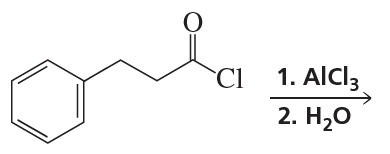
What are the products of the following reactions?
a. Chemical structure showing a chlorobenzene derivative with oxidation steps labeled: 1. AlCl3, 2. H2O.

검증된 단계별 안내
1
Analyze the given reactant structure: The molecule contains a benzene ring attached to a side chain with a tertiary carbon and two methyl groups.
Identify the reagent: H₂CrO₄ (chromic acid) is a strong oxidizing agent, typically used to oxidize primary and secondary alcohols, as well as benzylic carbons.
Determine the reaction site: The benzylic position (the carbon directly attached to the benzene ring) is susceptible to oxidation by chromic acid, especially if it has hydrogen atoms attached.
Predict the product: Chromic acid will oxidize the benzylic carbon to a carboxylic acid group, replacing the entire side chain beyond the benzylic carbon with a -COOH group.
Conclude the reaction: The final product will be benzoic acid, as the benzylic carbon is oxidized to a carboxylic acid group, and the rest of the side chain is removed.

비슷한 문제에 대한 검증된 영상 답변:

이 영상 해법은 위 문제에 도움이 된다고 튜터들이 추천한 것입니다.
영상 길이:
2m

주요 개념

질문에 올바르게 답하기 위해 반드시 이해해야 하는 핵심 개념들은 다음과 같습니다.

Oxidation of Aromatic Compounds

Aromatic compounds can undergo oxidation reactions, where the addition of oxygen or the removal of hydrogen occurs. In this case, the presence of H2CrO4, a strong oxidizing agent, facilitates the oxidation of the side chain of the aromatic compound, typically converting alkyl groups into carbonyl groups or carboxylic acids, depending on the structure and conditions.
추천 영상:
08:19
Intro to Aromaticity

Chromic Acid (H2CrO4) as an Oxidizing Agent

Chromic acid (H2CrO4) is a powerful oxidizing agent commonly used in organic chemistry to oxidize alcohols, aldehydes, and side chains of aromatic compounds. It can convert primary alcohols to carboxylic acids and secondary alcohols to ketones, making it essential for understanding the products of oxidation reactions involving aromatic compounds.
추천 영상:
05:53
Strong oxidizing agents

Mechanism of Electrophilic Aromatic Substitution

Electrophilic aromatic substitution (EAS) is a fundamental reaction mechanism in organic chemistry where an electrophile replaces a hydrogen atom on an aromatic ring. Understanding EAS is crucial for predicting the outcomes of reactions involving aromatic compounds, especially when considering how substituents on the ring can influence the reactivity and orientation of further reactions.
추천 영상:
06:52
EAS General Mechanism