Ch. 18 - Reactions of Benzene and Substituted Benzenes
Bruice - Organic Chemistry 8th Edition
Bruice8th EditionOrganic ChemistryISBN: 9780135213711당신이 사용하는 게 아니라요?교과서 변경
18장, 문제 69

Does m-xylene or p-xylene react more rapidly with Cl2 + FeCl3? Explain your answer.

검증된 단계별 안내
1
Step 1: Understand the reaction mechanism. The reaction between xylene and Cl₂ in the presence of FeCl₃ is an electrophilic aromatic substitution. FeCl₃ acts as a Lewis acid catalyst, generating the electrophile Cl⁺, which will attack the aromatic ring.
Step 2: Analyze the structure of m-xylene and p-xylene. Both are dimethylbenzene derivatives, but the positions of the methyl groups differ. In m-xylene, the methyl groups are located at the 1 and 3 positions, while in p-xylene, they are at the 1 and 4 positions.
Step 3: Consider the electron-donating effects of the methyl groups. Methyl groups are electron-donating via hyperconjugation and inductive effects, increasing the electron density of the aromatic ring. This makes the ring more reactive toward electrophilic attack. The positions of the methyl groups influence the distribution of electron density.
Step 4: Evaluate the steric hindrance. In m-xylene, the methyl groups are closer together, which can create steric hindrance and reduce the accessibility of certain positions on the ring for electrophilic attack. In p-xylene, the methyl groups are farther apart, reducing steric hindrance and making the ring more accessible for reaction.
Step 5: Conclude based on reactivity. Due to the reduced steric hindrance and more evenly distributed electron density, p-xylene reacts more rapidly with Cl₂ + FeCl₃ compared to m-xylene. The para position allows for easier electrophilic attack.

비슷한 문제에 대한 검증된 영상 답변:

이 영상 해법은 위 문제에 도움이 된다고 튜터들이 추천한 것입니다.
영상 길이:
3m

주요 개념

질문에 올바르게 답하기 위해 반드시 이해해야 하는 핵심 개념들은 다음과 같습니다.

Electrophilic Aromatic Substitution

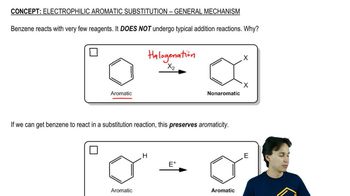
Electrophilic aromatic substitution (EAS) is a fundamental reaction mechanism in organic chemistry where an electrophile replaces a hydrogen atom on an aromatic ring. The reactivity of the aromatic compound is influenced by the substituents already present on the ring, which can either activate or deactivate the ring towards further substitution. Understanding EAS is crucial for predicting how different xylene isomers will react with electrophiles like Cl2 in the presence of a catalyst.
추천 영상:
03:07
EAS Review

Substituent Effects

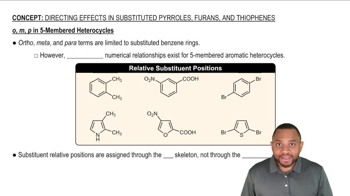
Substituent effects refer to how different groups attached to an aromatic ring influence its reactivity and orientation during electrophilic substitution reactions. Electron-donating groups (EDGs) enhance reactivity by stabilizing the positive charge in the intermediate, while electron-withdrawing groups (EWGs) decrease reactivity. In the case of m-xylene and p-xylene, the position of the methyl groups affects the electron density on the ring, thus impacting their reactivity with Cl2.
추천 영상:
가이드 코스
2:02
Directing Effects in Substituted Pyrroles, Furans, and Thiophenes Concept 1

Steric Hindrance

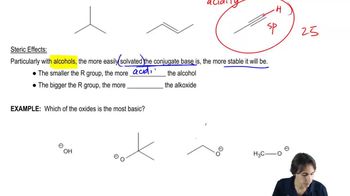
Steric hindrance is the prevention of chemical reactions due to the spatial arrangement of atoms within a molecule. In the context of xylene isomers, the position of the methyl groups can create steric effects that influence how easily the electrophile can approach and react with the aromatic ring. For example, p-xylene may experience more steric hindrance compared to m-xylene, affecting the rate of reaction with Cl2 and FeCl3.
추천 영상:
02:53
Understanding steric effects.