Ch. 18 - Reactions of Benzene and Substituted Benzenes
Bruice - Organic Chemistry 8th Edition
Bruice8th EditionOrganic ChemistryISBN: 9780135213711당신이 사용하는 게 아니라요?교과서 변경
18장, 문제 70(a)

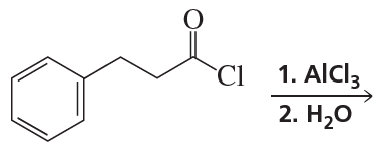
What are the products of the following reactions?
a. Chemical structure showing a benzene ring with an acyl chloride, labeled with reaction steps using AlCl3 and water.

검증된 단계별 안내
1
Step 1: Identify the type of reaction taking place. Determine whether the reaction is substitution, addition, elimination, or another type based on the reactants and conditions provided.
Step 2: Analyze the reactants. Look at the functional groups, molecular structure, and any reagents or catalysts involved in the reaction.
Step 3: Predict the mechanism of the reaction. For example, if it is a substitution reaction, determine whether it follows an SN1 or SN2 mechanism based on the substrate and conditions.
Step 4: Write out the intermediate steps of the reaction, if applicable. For instance, if the reaction involves a carbocation intermediate, show how it forms and rearranges.
Step 5: Determine the final products by completing the reaction mechanism and considering factors like regioselectivity, stereoselectivity, and stability of the products.

비슷한 문제에 대한 검증된 영상 답변:

이 영상 해법은 위 문제에 도움이 된다고 튜터들이 추천한 것입니다.

주요 개념

질문에 올바르게 답하기 위해 반드시 이해해야 하는 핵심 개념들은 다음과 같습니다.

Reaction Mechanisms

Understanding reaction mechanisms is crucial in organic chemistry as they describe the step-by-step process by which reactants transform into products. This includes identifying intermediates, transition states, and the types of bonds formed or broken during the reaction. Familiarity with mechanisms helps predict the products of reactions based on the nature of the reactants and conditions.
추천 영상:
02:16
Heck Reaction Mechanism

Functional Groups

Functional groups are specific groups of atoms within molecules that are responsible for the characteristic chemical reactions of those molecules. Recognizing functional groups is essential for predicting the behavior of organic compounds in reactions, as they dictate reactivity, polarity, and the types of products formed. Common functional groups include alcohols, carboxylic acids, and amines.
추천 영상:
02:36
Identifying Functional Groups

Stoichiometry

Stoichiometry involves the calculation of reactants and products in chemical reactions based on the conservation of mass. It allows chemists to determine the proportions of substances involved in reactions, which is vital for predicting yields and understanding the efficiency of reactions. Mastery of stoichiometry is essential for accurately determining the products and their quantities in organic reactions.
추천 영상:
02:08
Organic molecules in your everyday life.