Ch. 20 - The Organic Chemistry of Carbohydrates
Bruice - Organic Chemistry 8th Edition
Bruice8th EditionOrganic ChemistryISBN: 9780135213711당신이 사용하는 게 아니라요?교과서 변경
20장, 문제 62

A hexose is obtained when the residue of a shrub Sterculia setigeria undergoes acid-catalyzed hydrolysis. Identify the hexose from the following experimental information: it undergoes mutarotation; it does not react with Br2; and D-galactonic acid and D-talonic acid are formed when it reacts with Tollens’ reagent.

검증된 단계별 안내
1
Step 1: Understand the problem and identify the key experimental observations. The hexose undergoes mutarotation, does not react with Br₂, and forms d-galactonic acid and d-talonic acid when treated with Tollens’ reagent. These observations provide clues about the structure and reactivity of the hexose.
Step 2: Analyze the mutarotation property. Mutarotation occurs when a sugar exists in equilibrium between its α- and β-anomeric forms in solution, indicating the presence of a hemiacetal functional group. This suggests that the hexose is a reducing sugar.
Step 3: Consider the lack of reaction with Br₂. Bromine water selectively oxidizes aldehydes to carboxylic acids. The fact that the hexose does not react with Br₂ implies that it does not have a free aldehyde group in its open-chain form, suggesting it is a ketose rather than an aldose.
Step 4: Examine the reaction with Tollens’ reagent. Tollens’ reagent oxidizes reducing sugars to their corresponding aldonic acids. The formation of d-galactonic acid and d-talonic acid indicates that the hexose is epimeric at two positions, specifically at C-2 and C-4, which are characteristic of d-galactose and d-tagatose.
Step 5: Conclude the identity of the hexose. Based on the experimental data, the hexose must be d-tagatose, a ketose that undergoes mutarotation, does not react with Br₂, and forms d-galactonic acid and d-talonic acid upon oxidation with Tollens’ reagent.

비슷한 문제에 대한 검증된 영상 답변:

이 영상 해법은 위 문제에 도움이 된다고 튜터들이 추천한 것입니다.
영상 길이:
5m

주요 개념

질문에 올바르게 답하기 위해 반드시 이해해야 하는 핵심 개념들은 다음과 같습니다.

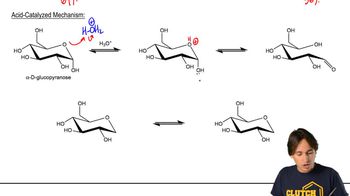
Mutarotation

Mutarotation is the change in optical rotation that occurs when an α-anomer of a sugar converts to its β-anomer in solution. This process is significant for hexoses, as it indicates the presence of an anomeric carbon, which can interconvert between different cyclic forms. The observation of mutarotation in the hexose suggests it is a reducing sugar capable of forming an equilibrium between its anomeric forms.
추천 영상:
03:06
Mechanism

Tollens' Reagent

Tollens' reagent is a solution of silver nitrate in ammonia, used to test for aldehydes and reducing sugars. When a sugar reacts with Tollens' reagent, it indicates the presence of an aldehyde functional group, which is characteristic of reducing sugars. The formation of d-galactonic acid and d-talonic acid upon reaction with Tollens' reagent suggests that the hexose in question has an aldehyde group that can be oxidized.
추천 영상:
01:52
Reagents

Non-reaction with Br2

The non-reaction of a sugar with bromine (Br2) indicates that it is not a strong reducing agent, which is typical for certain hexoses. In organic chemistry, sugars that do not react with Br2 are often those that lack a free aldehyde group or are in a stable cyclic form. This characteristic helps narrow down the identity of the hexose, as it suggests that the sugar is likely a ketose or a specific aldose that does not readily oxidize.
추천 영상:
06:42
Understanding Non-IUPAC Substituents