Ch. 20 - The Organic Chemistry of Carbohydrates
Bruice - Organic Chemistry 8th Edition
Bruice8th EditionOrganic ChemistryISBN: 9780135213711당신이 사용하는 게 아니라요?교과서 변경
20장, 문제 61

How many aldaric acids are obtained from the 16 aldohexoses?

검증된 단계별 안내
1
Understand the concept of aldaric acids: Aldaric acids are dicarboxylic acids formed by the oxidation of both the aldehyde group (C-1) and the primary alcohol group (C-6) of an aldose sugar. For aldohexoses, this means oxidizing both ends of the six-carbon sugar molecule.
Recognize the structural diversity of aldohexoses: There are 16 aldohexoses, which include 8 D-isomers and 8 L-isomers. These isomers differ in the stereochemistry of their chiral centers (C-2, C-3, C-4, and C-5).
Determine the effect of oxidation on stereochemistry: Oxidation of the aldehyde and primary alcohol groups does not affect the stereochemistry of the chiral centers (C-2, C-3, C-4, and C-5). Therefore, the stereochemical configuration of the original aldohexose is preserved in the resulting aldaric acid.
Account for potential meso compounds: Some aldaric acids may be meso compounds, which are achiral despite having chiral centers. Meso compounds result when the molecule has an internal plane of symmetry. For aldaric acids, this occurs when the stereochemistry of the chiral centers is symmetric about the central carbon (C-3).
Count the unique aldaric acids: Analyze the stereochemical configurations of the 16 aldohexoses to determine how many unique aldaric acids are formed, considering both enantiomers and any meso compounds. This involves identifying pairs of enantiomers and any meso compounds that reduce the total count of unique aldaric acids.

비슷한 문제에 대한 검증된 영상 답변:

이 영상 해법은 위 문제에 도움이 된다고 튜터들이 추천한 것입니다.
영상 길이:
7m

주요 개념

질문에 올바르게 답하기 위해 반드시 이해해야 하는 핵심 개념들은 다음과 같습니다.

Aldoses and Aldohexoses

Aldoses are a type of monosaccharide that contain an aldehyde group. Aldohexoses specifically refer to six-carbon aldoses, which include sugars like glucose and galactose. Understanding the structure and properties of these sugars is essential for determining the types of aldaric acids that can be derived from them.
추천 영상:
02:29
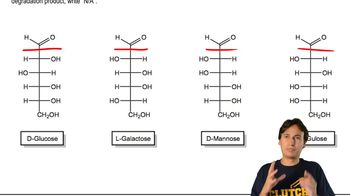
Which aldohexoses produce the same Wohl Degradation product

Aldaric Acids

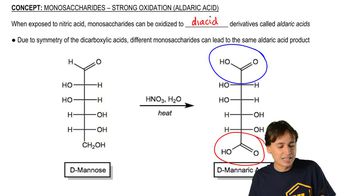
Aldaric acids are dicarboxylic acids formed by the oxidation of both the aldehyde and the primary alcohol groups in aldoses. For each aldohexose, the oxidation leads to a unique aldaric acid, which retains the carbon skeleton of the original sugar. This concept is crucial for calculating the total number of distinct aldaric acids from the given aldohexoses.
추천 영상:
03:10
Monosaccharides - Strong Oxidation (Aldaric Acid)

Isomerism in Sugars

Isomerism refers to the existence of compounds with the same molecular formula but different structural arrangements. In the case of aldohexoses, there are multiple isomers due to variations in the arrangement of hydroxyl groups and the configuration around the chiral centers. Recognizing these isomers is important for understanding how many unique aldaric acids can be produced from the 16 aldohexoses.
추천 영상:
08:42
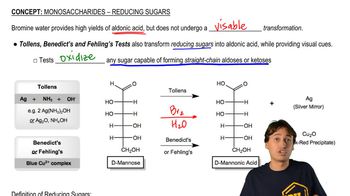
Reducing Sugars
관련 실천
교과서 질문

The aldaric acid of D-glucose forms two five-membered-ring lactones. Draw their structures.

1460
views

교과서 질문

Draw each of the following:

a. β-D-talopyranose

b. α-D-idopyranose  

790
views
교과서 질문

A hexose is obtained when the residue of a shrub Sterculia setigeria undergoes acid-catalyzed hydrolysis. Identify the hexose from the following experimental information: it undergoes mutarotation; it does not react with Br2; and D-galactonic acid and D-talonic acid are formed when it reacts with Tollens’ reagent.

911
views
교과서 질문

Hyaluronic acid, a component of connective tissue, is the fluid that lubricates joints. It is a polymer of alternating N-acetyl-D-glucosamine and D-glucuronic acid subunits joined by β-1,3′-glycosidic linkages. Draw a short segment of hyaluronic acid.

822
views
교과서 질문

Draw the mechanism for the formation of β-lactose from ⍺-D-galactose and β-D-glucose in dilute HCl.

1129
views
교과서 질문

Calculate the percentages of α\(\alpha\)-D-glucose and β\(\beta\)-D-glucose present at equilibrium from the specific rotations of α\(\alpha\)-D-glucose, β\(\beta\)-D-glucose, and the equilibrium mixture. Compare your values with those given in Section 20.10. (Hint: The specific rotation of the mixture equals the specific rotation of α\(\alpha\)-D-glucose times the fraction of glucose present in the a-form plus the specific rotation of β\(\beta\)-D-glucose times the fraction of glucose present in the β\(\beta\) -form.)

1029
views