뒤로
뒤로
문제 57
Threonine, an amino acid, has four stereoisomers. The stereoisomer found in nature is (2S,3R)-threonine. Which of the following structures represents the naturally occurring amino acid?
문제 59
Convert the Fischer projection to a perspective formula.
문제 61
Convert the perspective formula to a skeletal structure.
문제 63
Explain why compound A has two stereoisomers but compounds B and C exist as single compounds.
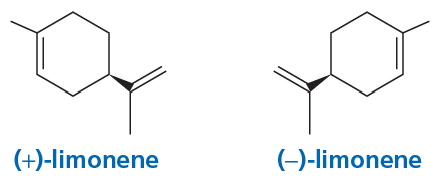
문제 64
Limonene exists as two different stereoisomers. The R enantiomer is found in oranges and lemons, and the S enantiomer is found in spruce trees. Which of the following is found in oranges and lemons?
문제 65
Disregarding stereoisomers, draw the structures of all alkenes with molecular formula C5H10. Which ones can exist as cis–trans isomers?
문제 66a,b
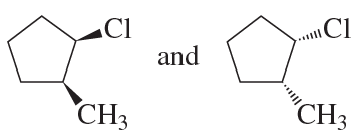
Draw all possible stereoisomers for each of the following. Indicate those compounds for which no stereoisomers are possible.
a. 1-bromo-2-chlorocyclohexane
b. 2-bromo-4-methylpentane
문제 66c,d
Draw all possible stereoisomers for each of the following. Indicate those compounds for which no stereoisomers are possible.
c. 1,2-dichlorocyclohexane
d. 2-bromo-4-chloropentane
문제 66e,f
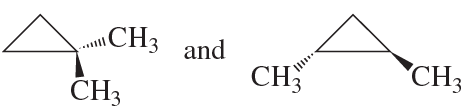
Draw all possible stereoisomers for each of the following. Indicate those compounds for which no stereoisomers are possible.
e. 1-bromo-4-chlorocyclohexane
f. 1,2-dimethylcyclopropane
문제 67
Which of the following has an asymmetric center?
CHBr2Cl, BHFCl, CH3CHCl2, CHFBrCl, BeHCl
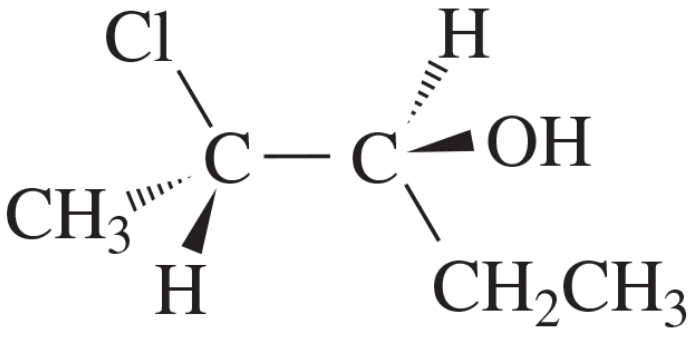
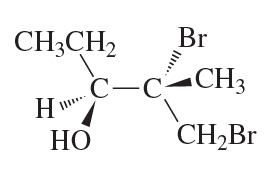
문제 68c
Name the following compounds using R,S designations:
c.
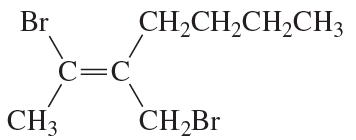
문제 70c,d
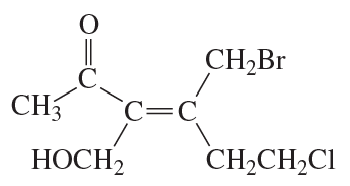
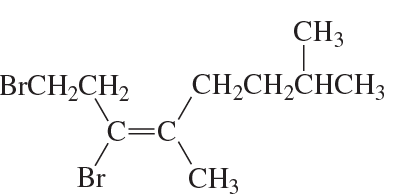
Do the following compounds have the E or the Z configuration?
c.
d.
문제 70e
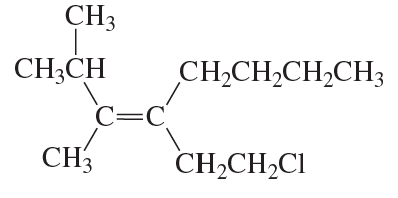
Do the following compounds have the E or the Z configuration?
e.
문제 70f
Do the following compounds have the E or the Z configuration?
f.
문제 71c,d
Are the following pairs identical, enantiomers, diastereomers, or constitutional isomers?
c.
d.
문제 71e,f
Are the following pairs identical, enantiomers, diastereomers, or constitutional isomers?
e.
f.
문제 72c
Assign relative priorities to each set of substituents:
c. -C(=O)CH3, -CH=CH2, -Cl, -C=N
문제 73a,b
Draw the structure for a compound with molecular formula C2H2I2F2
a. that is optically inactive because it does not have an asymmetric center.
b. that is optically inactive because it is a meso compound.
문제 73c
Draw the structure for a compound with molecular formula C2H2I2F2
c. that is optically active.
문제 74
Which of the following are optically active?
문제 75
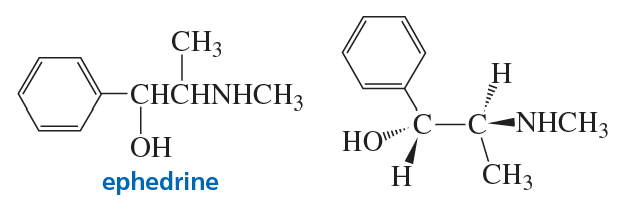
For many centuries, the Chinese have used extracts from a group of herbs known as ephedra to treat asthma. A compound named ephedrine has been isolated from these herbs and found to be a potent dilator of air passages in the lungs.
a. How many stereoisomers does ephedrine have?
b. The stereoisomer shown here is the one that is pharmacologically active. What is the configuration of each of the asymmetric centers?
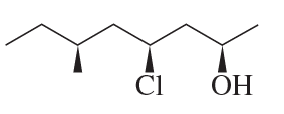
문제 76c
Name the following:
c.
문제 77a,b
Which of the following has an achiral stereoisomer?
a. 2,3-dichlorobutane
b. 2,3-dichloropentane
문제 77e,f
Which of the following has an achiral stereoisomer?
e. 1,3-dibromocyclobutane
f. 2,4-dibromopentane
문제 77i,j
Which of the following has an achiral stereoisomer?
i. 1,2-dimethylcyclopentane
j, 1,2-dimethylcyclobutane
문제 79a,b
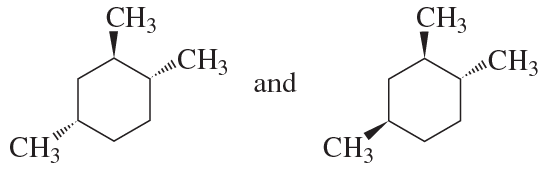
Are the following pairs identical, enantiomers, diastereomers, or constitutional isomers?
a.
b.
문제 80a
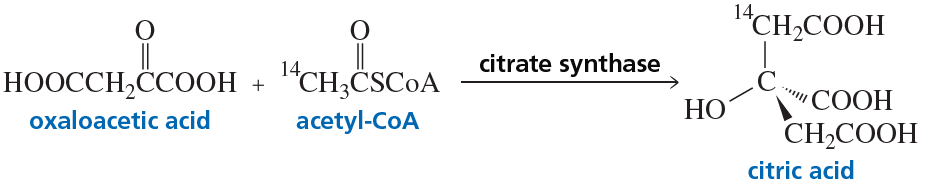
Citrate synthase, one of the enzymes in the series of enzyme-catalyzed reactions known as the citric acid cycle, catalyzes the synthesis of citric acid from oxaloacetic acid and acetyl-CoA. If the synthesis is carried out with acetyl-CoA that contains radioactive carbon (14C) in the indicated position, the isomer shown here is obtained.
a. Which stereoisomer of citric acid is synthesized: R or S?
문제 80b
Citrate synthase, one of the enzymes in the series of enzyme-catalyzed reactions known as the citric acid cycle, catalyzes the synthesis of citric acid from oxaloacetic acid and acetyl-CoA. If the synthesis is carried out with acetyl-CoA that contains radioactive carbon (14C) in the indicated position, the isomer shown here is obtained.
b. If the acetyl-CoA used in the synthesis contains 12C instead of 14C, will the product of the reaction be chiral or achiral?
문제 81
A solution of an unknown compound (3.0 g of the compound in 200 mL of solution), when placed in a polarimeter tube 2.0 dm long, was found to rotate the plane of polarized light 18° in a counterclockwise direction. What is the specific rotation of the compound?
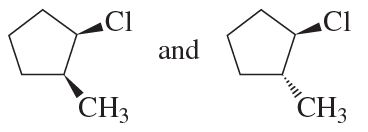
문제 82c,d
Are the following pairs identical, enantiomers, diastereomers, or constitutional isomers?
c.
d.