Ch. 9 - Substitution and Elimination Reactions of Alkyl Halides
Bruice - Organic Chemistry 8th Edition
Bruice8th EditionOrganic ChemistryISBN: 9780135213711당신이 사용하는 게 아니라요?교과서 변경
9장, 문제 120a(1)

Draw the product of each of the following reactions:
1.

검증된 단계별 안내
1
Step 1: Analyze the given reactants and reagents. The starting material is CH3CH2C≡CH (1-butyne), and the reaction involves two steps: (1) NaNH2 (sodium amide) and (2) CH3CH2Br (ethyl bromide). Sodium amide is a strong base that can deprotonate terminal alkynes, generating an acetylide ion.
Step 2: In the first step, NaNH2 deprotonates the terminal alkyne (CH3CH2C≡CH) to form the corresponding acetylide ion (CH3CH2C≡C⁻). This occurs because the terminal hydrogen on the alkyne is acidic and can be removed by a strong base.
Step 3: In the second step, the acetylide ion (CH3CH2C≡C⁻) acts as a nucleophile and undergoes an SN2 reaction with CH3CH2Br (ethyl bromide). The bromine atom in CH3CH2Br is a good leaving group, allowing the nucleophilic substitution to occur.
Step 4: The nucleophilic attack by the acetylide ion on the ethyl bromide results in the formation of a new carbon-carbon bond. The product of this reaction is an internal alkyne, specifically CH3CH2C≡CCH2CH3.
Step 5: Verify the structure of the product by ensuring that the reaction mechanism is consistent with the reagents used (deprotonation followed by nucleophilic substitution) and that the final product is an internal alkyne with the correct connectivity.

비슷한 문제에 대한 검증된 영상 답변:

이 영상 해법은 위 문제에 도움이 된다고 튜터들이 추천한 것입니다.
영상 길이:
2m

주요 개념

질문에 올바르게 답하기 위해 반드시 이해해야 하는 핵심 개념들은 다음과 같습니다.

Alkyne Reactivity

Alkynes are hydrocarbons containing a carbon-carbon triple bond, which makes them highly reactive. In organic reactions, they can undergo various transformations, including nucleophilic substitutions and eliminations. Understanding the reactivity of alkynes is crucial for predicting the products of reactions involving them.
추천 영상:
09:11
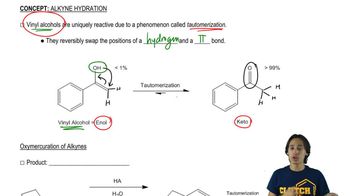
Alkyne Hydration

Nucleophilic Substitution

Nucleophilic substitution is a fundamental reaction mechanism in organic chemistry where a nucleophile replaces a leaving group in a molecule. In this case, sodium amide (NaNH2) acts as a strong nucleophile, facilitating the substitution of a hydrogen atom in the alkyne with a bromine atom from bromoethane (CH3CH2Br). This concept is essential for determining the final product of the reaction.
추천 영상:
01:47
Nucleophiles and Electrophiles can react in Substitution Reactions.

Reaction Mechanism

A reaction mechanism describes the step-by-step process by which reactants are converted into products. It includes the identification of intermediates, transition states, and the overall energy changes. Understanding the mechanism of the reaction between the alkyne and sodium amide is vital for predicting the structure of the final product and the pathway taken during the reaction.
추천 영상:
02:16
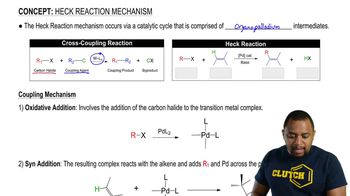
Heck Reaction Mechanism