Ch. 9 - Substitution and Elimination Reactions of Alkyl Halides
Bruice - Organic Chemistry 8th Edition
Bruice8th EditionOrganic ChemistryISBN: 9780135213711당신이 사용하는 게 아니라요?교과서 변경
9장, 문제 120c

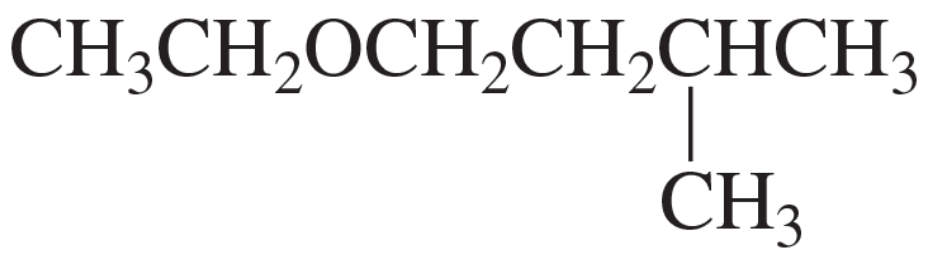
Give two sets of reactants (each set including an alkyl halide and a nucleophile) that could be used to synthesize the following ether:

검증된 단계별 안내
1
Step 1: Analyze the ether structure provided. The ether has two alkyl groups attached to the oxygen atom: one is a tert-butyl group (C(CH3)3), and the other is an isopropyl group (CH(CH3)2). This indicates that the ether can be synthesized using two different sets of reactants: an alkyl halide and a nucleophile.
Step 2: Recall the Williamson Ether Synthesis mechanism. This reaction involves an alkoxide ion (nucleophile) reacting with an alkyl halide via an SN2 mechanism to form an ether. The alkoxide ion is typically generated by deprotonating an alcohol with a strong base.
Step 3: For the first set of reactants, choose tert-butyl bromide (C(CH3)3Br) as the alkyl halide and isopropoxide ion (CH(CH3)2O⁻) as the nucleophile. The isopropoxide ion can be prepared by treating isopropanol (CH(CH3)2OH) with a strong base like NaH or NaOH.
Step 4: For the second set of reactants, choose isopropyl bromide (CH(CH3)2Br) as the alkyl halide and tert-butoxide ion (C(CH3)3O⁻) as the nucleophile. The tert-butoxide ion can be prepared by treating tert-butanol (C(CH3)3OH) with a strong base like NaH or NaOH.
Step 5: Ensure that the chosen alkyl halide and nucleophile pair avoids steric hindrance issues during the SN2 reaction. For example, the tert-butoxide ion is bulky, so it is better used as the nucleophile when reacting with a less hindered alkyl halide like isopropyl bromide.

비슷한 문제에 대한 검증된 영상 답변:

이 영상 해법은 위 문제에 도움이 된다고 튜터들이 추천한 것입니다.
영상 길이:
2m

주요 개념

질문에 올바르게 답하기 위해 반드시 이해해야 하는 핵심 개념들은 다음과 같습니다.

Williamson Ether Synthesis

Williamson Ether Synthesis is a method for creating ethers through the reaction of an alkoxide ion with a primary alkyl halide. This reaction involves nucleophilic substitution, where the alkoxide acts as a nucleophile, attacking the electrophilic carbon of the alkyl halide, leading to the formation of an ether. The choice of reactants is crucial, as steric hindrance can affect the reaction's success.
추천 영상:
03:50
The Mechanism of Williamson Ether Synthesis.

Alkyl Halides

Alkyl halides are organic compounds containing a carbon atom bonded to a halogen atom (such as chlorine, bromine, or iodine). They serve as electrophiles in nucleophilic substitution reactions, making them essential reactants in ether synthesis. The structure of the alkyl halide, particularly whether it is primary, secondary, or tertiary, influences the reaction pathway and the feasibility of the Williamson Ether Synthesis.
추천 영상:
01:52
How to name alkyl halides

Nucleophiles

Nucleophiles are species that donate an electron pair to form a chemical bond in a reaction. In the context of ether synthesis, nucleophiles such as alkoxides or amines are crucial as they attack the electrophilic carbon of alkyl halides. The strength and structure of the nucleophile can significantly affect the reaction rate and the selectivity of the ether formation.
추천 영상:
08:27
Nucleophilic Addition