Ch. 9 - Substitution and Elimination Reactions of Alkyl Halides
Bruice - Organic Chemistry 8th Edition
Bruice8th EditionOrganic ChemistryISBN: 9780135213711당신이 사용하는 게 아니라요?교과서 변경
9장, 문제 120a(2)

Draw the product of each of the following reactions:
2.

검증된 단계별 안내
1
Step 1: Recognize the type of reaction. This is a substitution reaction where the hydroxyl group (-OH) in CH3CH2CH2OH (1-propanol) is replaced by a bromine atom (Br). The reaction involves two steps: deprotonation and substitution.
Step 2: In the first step, NaH (sodium hydride) acts as a strong base. It reacts with the hydroxyl group (-OH) of CH3CH2CH2OH to form an alkoxide ion (CH3CH2CH2O⁻) and hydrogen gas (H2). Write the reaction as: CH3CH2CH2OH + NaH → CH3CH2CH2O⁻ + H2.
Step 3: In the second step, the alkoxide ion (CH3CH2CH2O⁻) reacts with CH3Br (methyl bromide) in an SN2 reaction. The nucleophilic alkoxide ion attacks the carbon atom in CH3Br, displacing the bromide ion (Br⁻) and forming the product CH3CH2CH2OCH3 (propyl methyl ether).
Step 4: Draw the structure of the product. The product is an ether with the structure CH3CH2CH2OCH3, where the oxygen atom is bonded to a propyl group (CH3CH2CH2-) and a methyl group (CH3-).
Step 5: Verify the reaction mechanism and product. Ensure that the reaction follows the expected SN2 mechanism, where the nucleophile (alkoxide ion) attacks the electrophilic carbon in CH3Br, leading to the substitution product.

비슷한 문제에 대한 검증된 영상 답변:

이 영상 해법은 위 문제에 도움이 된다고 튜터들이 추천한 것입니다.
영상 길이:
2m

주요 개념

질문에 올바르게 답하기 위해 반드시 이해해야 하는 핵심 개념들은 다음과 같습니다.

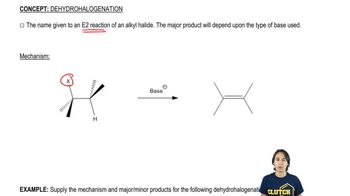
Dehydrohalogenation

Dehydrohalogenation is a chemical reaction that involves the elimination of a hydrogen halide from an alkyl halide, often leading to the formation of alkenes. In the context of the given reaction, sodium hydride (NaH) acts as a strong base, facilitating the removal of a proton from the alcohol (CH3CH2CH2OH) and generating an alkoxide intermediate, which can then react further.
추천 영상:
03:02
The dehydrohalogenation mechanism.

Nucleophilic Substitution

Nucleophilic substitution is a fundamental reaction in organic chemistry where a nucleophile replaces a leaving group in a molecule. In this case, the alkoxide formed from the alcohol can act as a nucleophile, attacking the electrophilic carbon in methyl bromide (CH3Br) to produce an ether or an alkane, depending on the reaction conditions and stoichiometry.
추천 영상:
01:47
Nucleophiles and Electrophiles can react in Substitution Reactions.

Reaction Mechanism

Understanding the reaction mechanism is crucial for predicting the products of organic reactions. The mechanism outlines the step-by-step process of how reactants transform into products, including the formation of intermediates and the breaking and forming of bonds. In this scenario, recognizing the sequence of deprotonation and nucleophilic attack will help in accurately drawing the final product of the reaction.
추천 영상:
02:16
Heck Reaction Mechanism