Ch. 9 - Substitution and Elimination Reactions of Alkyl Halides
Bruice - Organic Chemistry 8th Edition
Bruice8th EditionOrganic ChemistryISBN: 9780135213711당신이 사용하는 게 아니라요?교과서 변경
9장, 문제 96c,d

For each of the following alkyl halides, indicate the stereoisomer that would be obtained in greatest yield in an E2 reaction.
c. 3-bromo-2,3-dimethylpentane
d. 3-bromo-3,4-dimethylhexane

검증된 단계별 안내
1
Step 1: Recall the mechanism of an E2 reaction. E2 reactions are bimolecular eliminations where a base removes a β-hydrogen, and the leaving group departs simultaneously, forming a double bond. The reaction is stereospecific, favoring the anti-periplanar geometry of the β-hydrogen and the leaving group.
Step 2: Analyze the structure of 3-bromo-2,3-dimethylpentane. Identify the β-hydrogens available for elimination. Look for hydrogens on carbons adjacent to the carbon bonded to the bromine atom. Consider the anti-periplanar geometry to determine which β-hydrogen can be eliminated.
Step 3: Determine the stereoisomer formed in the elimination of 3-bromo-2,3-dimethylpentane. The anti-periplanar geometry dictates that the elimination will occur in a specific direction, forming the most stable alkene. Stability is influenced by factors such as substitution (more substituted alkenes are more stable) and steric hindrance.
Step 4: Analyze the structure of 3-bromo-3,4-dimethylhexane. Similar to the previous case, identify the β-hydrogens adjacent to the carbon bonded to the bromine atom. Again, focus on the anti-periplanar geometry to determine which β-hydrogen can be eliminated.
Step 5: Determine the stereoisomer formed in the elimination of 3-bromo-3,4-dimethylhexane. Consider the anti-periplanar geometry and the stability of the resulting alkene. The most substituted alkene will generally be favored, and steric hindrance should also be taken into account.

비슷한 문제에 대한 검증된 영상 답변:

이 영상 해법은 위 문제에 도움이 된다고 튜터들이 추천한 것입니다.
영상 길이:
5m

주요 개념

질문에 올바르게 답하기 위해 반드시 이해해야 하는 핵심 개념들은 다음과 같습니다.

E2 Reaction Mechanism

The E2 (bimolecular elimination) reaction is a concerted process where a base abstracts a proton while a leaving group departs, resulting in the formation of a double bond. This mechanism typically requires a strong base and occurs in a single step, leading to the formation of alkenes. The stereochemistry of the substrate plays a crucial role, as the reaction favors anti-periplanar geometry for optimal overlap of orbitals.
추천 영상:
09:36
Drawing the E2 Mechanism.

Stereochemistry and Stereoisomers

Stereochemistry refers to the spatial arrangement of atoms in molecules and how this affects their chemical behavior. Stereoisomers are compounds with the same molecular formula and connectivity but different spatial orientations. In E2 reactions, the stereochemistry of the alkyl halide influences which stereoisomer is formed preferentially, often favoring the more stable trans or E isomer due to steric factors.
추천 영상:
가이드 코스
1:38
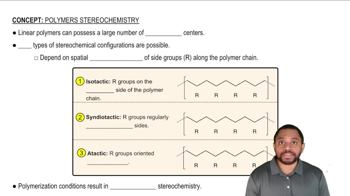
Polymer Stereochemistry Concept 1

Zaitsev's Rule

Zaitsev's Rule states that in elimination reactions, the more substituted alkene (the one with more alkyl groups attached to the double bond) is typically the major product. This is because more substituted alkenes are generally more stable due to hyperconjugation and the inductive effect. Understanding this rule helps predict which stereoisomer will be formed in greater yield during E2 reactions involving alkyl halides.
추천 영상:
01:18
Defining Zaitsev’s Rule