Ch. 9 - Substitution and Elimination Reactions of Alkyl Halides
Bruice - Organic Chemistry 8th Edition
Bruice8th EditionOrganic ChemistryISBN: 9780135213711당신이 사용하는 게 아니라요?교과서 변경
9장, 문제 97

Which of following ethers cannot be made by a Williamson ether synthesis?

검증된 단계별 안내
1
Step 1: Understand the Williamson ether synthesis mechanism. It involves the reaction of an alkoxide ion (RO⁻) with a primary or secondary alkyl halide (R'X) via an SN2 mechanism to form an ether (ROR').
Step 2: Analyze the structures of the ethers provided (i, ii, iii, iv). Look for steric hindrance in the alkyl halide component, as SN2 reactions are hindered by bulky groups.
Step 3: For ether (i), the alkyl groups attached to the oxygen are relatively bulky, but the synthesis is possible if the alkyl halide is not overly hindered.
Step 4: For ether (ii), the alkyl groups are highly branched, and the formation of this ether via Williamson synthesis is unlikely due to steric hindrance preventing the SN2 reaction.
Step 5: For ethers (iii) and (iv), the alkyl groups are less hindered compared to ether (ii, making their synthesis via Williamson ether synthesis more feasible. Thus, ether (ii) cannot be made by Williamson ether synthesis.

비슷한 문제에 대한 검증된 영상 답변:

이 영상 해법은 위 문제에 도움이 된다고 튜터들이 추천한 것입니다.
영상 길이:
2m

주요 개념

질문에 올바르게 답하기 위해 반드시 이해해야 하는 핵심 개념들은 다음과 같습니다.

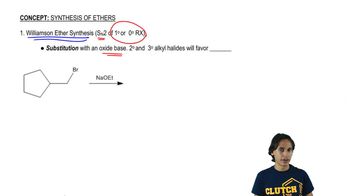
Williamson Ether Synthesis

Williamson ether synthesis is a method for creating ethers through the reaction of an alkoxide ion with a primary alkyl halide. This reaction involves nucleophilic substitution, where the alkoxide acts as a nucleophile, attacking the electrophilic carbon of the alkyl halide. The reaction is most effective with primary halides to avoid steric hindrance and elimination reactions.
추천 영상:
03:50
The Mechanism of Williamson Ether Synthesis.

Nucleophilicity and Sterics

Nucleophilicity refers to the ability of a nucleophile to donate an electron pair to form a bond with an electrophile. In the context of Williamson ether synthesis, steric hindrance plays a crucial role; bulky nucleophiles or electrophiles can hinder the reaction. Therefore, primary alkyl halides are preferred to minimize steric effects, while secondary or tertiary halides may lead to elimination rather than substitution.
추천 영상:
08:27
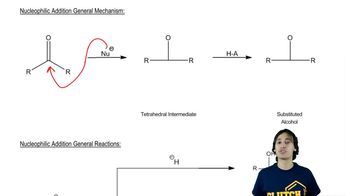
Nucleophilic Addition

Substitution Reactions

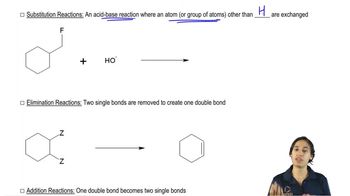
Substitution reactions involve the replacement of one functional group in a molecule with another. In Williamson ether synthesis, the reaction is typically an SN2 mechanism, where the nucleophile attacks the electrophile from the opposite side of the leaving group. Understanding the nature of the leaving group and the structure of the reactants is essential to predict the feasibility of the ether formation.
추천 영상:
01:34
Recognizing Substitution Reactions.