Ch. 9 - Substitution and Elimination Reactions of Alkyl Halides
Bruice - Organic Chemistry 8th Edition
Bruice8th EditionOrganic ChemistryISBN: 9780135213711당신이 사용하는 게 아니라요?교과서 변경
9장, 문제 98

When 2-bromo-2,3-dimethylbutane reacts with a strong base, two alkenes (2,3-dimethyl-1-butene and 2,3-dimethyl-2-butene) are formed.
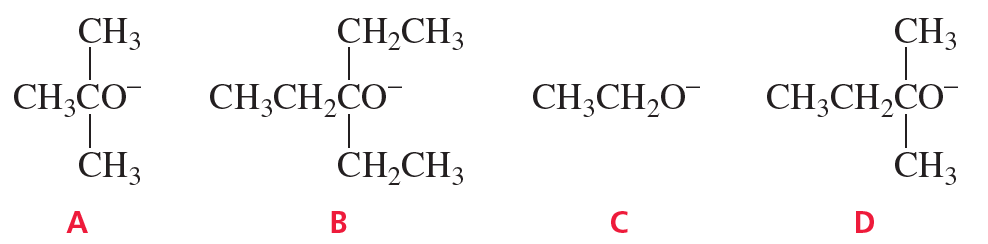
a. Which of the bases (A, B, C, or D) would form the highest percentage of the 1-alkene?
b. Which would give the highest percentage of the 2-alkene?
Structural formulas of four bases labeled A, B, C, and D, used to analyze alkene formation from a specific reaction.

검증된 단계별 안내
1
Step 1: Analyze the reaction mechanism. The reaction involves the elimination of HBr from 2-bromo-2,3-dimethylbutane in the presence of a strong base. This is an E2 elimination reaction, where the base abstracts a proton from a β-carbon, leading to the formation of a double bond.
Step 2: Identify the possible β-hydrogens. In the given molecule, there are two sets of β-hydrogens available for elimination: one leading to the formation of 2,3-dimethyl-1-butene (1-alkene) and the other leading to 2,3-dimethyl-2-butene (2-alkene).
Step 3: Consider the regioselectivity of the elimination. The formation of the 1-alkene follows the anti-Zaitsev rule (less substituted alkene), which is favored by bulky bases. The formation of the 2-alkene follows the Zaitsev rule (more substituted alkene), which is favored by smaller bases.
Step 4: Match the bases to the products. Bulky bases like tert-butoxide (Base A) will favor the formation of the 1-alkene, while smaller bases like hydroxide (Base B) or ethoxide (Base C) will favor the formation of the 2-alkene.
Step 5: Predict the outcomes. Base A (bulky base) will give the highest percentage of 2,3-dimethyl-1-butene (1-alkene), while Base B or Base C (smaller bases) will give the highest percentage of 2,3-dimethyl-2-butene (2-alkene).

비슷한 문제에 대한 검증된 영상 답변:

이 영상 해법은 위 문제에 도움이 된다고 튜터들이 추천한 것입니다.
영상 길이:
3m

주요 개념

질문에 올바르게 답하기 위해 반드시 이해해야 하는 핵심 개념들은 다음과 같습니다.

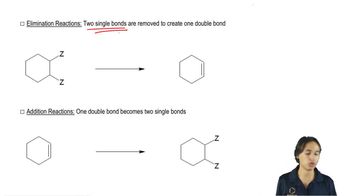
Elimination Reactions

Elimination reactions involve the removal of a leaving group and a hydrogen atom from adjacent carbon atoms, resulting in the formation of a double bond. In this context, the strong base facilitates the elimination of bromine from 2-bromo-2,3-dimethylbutane, leading to the formation of alkenes. Understanding the mechanism of elimination, particularly E2 reactions, is crucial for predicting the products formed.
추천 영상:
00:40
Recognizing Elimination Reactions.

Zaitsev's Rule

Zaitsev's Rule states that in elimination reactions, the more substituted alkene is generally favored as the major product. This principle helps predict that 2,3-dimethyl-2-butene, being more substituted than 2,3-dimethyl-1-butene, will be the predominant product when a strong base is used. Recognizing the implications of this rule is essential for determining the distribution of alkene products.
추천 영상:
01:18
Defining Zaitsev’s Rule

Regioselectivity

Regioselectivity refers to the preference of a chemical reaction to yield one structural isomer over others. In the case of the reaction between 2-bromo-2,3-dimethylbutane and a strong base, understanding which base promotes the formation of either the 1-alkene or the 2-alkene is crucial. Factors such as sterics and the strength of the base influence the regioselectivity of the elimination products.
추천 영상:
05:09
Heck Reaction