Ch. 9 - Substitution and Elimination Reactions of Alkyl Halides
Bruice - Organic Chemistry 8th Edition
Bruice8th EditionOrganic ChemistryISBN: 9780135213711당신이 사용하는 게 아니라요?교과서 변경
9장, 문제 107

In which solvent—ethanol or diethyl ether—would the equilibrium for the following SN2 reaction lie farther to the right?

검증된 단계별 안내
1
Step 1: Understand the reaction type. This is an SN2 reaction, which involves a single-step mechanism where the nucleophile attacks the electrophile, displacing the leaving group. The reaction rate and equilibrium are influenced by the solvent used.
Step 2: Analyze the solvents. Ethanol is a polar protic solvent, meaning it can form hydrogen bonds and stabilize ions like Br⁻ through solvation. Diethyl ether, on the other hand, is a polar aprotic solvent, which does not form hydrogen bonds but can stabilize cations through dipole interactions.
Step 3: Consider the role of the solvent in stabilizing the products. In this reaction, the products include CH₃SCH₃⁺ (a positively charged species) and Br⁻ (a negatively charged ion). Ethanol, being polar protic, will stabilize Br⁻ more effectively than diethyl ether, potentially shifting the equilibrium farther to the right.
Step 4: Evaluate the nucleophile and electrophile. The nucleophile (CH₃SCH₃) and electrophile (CH₃Br) are less affected by the solvent compared to the stabilization of the ionic products. Therefore, the solvent's ability to stabilize the ions is the key factor in determining the equilibrium position.
Step 5: Conclude the solvent's effect on equilibrium. Since ethanol can stabilize the ionic products better than diethyl ether, the equilibrium for this SN2 reaction would lie farther to the right in ethanol compared to diethyl ether.

비슷한 문제에 대한 검증된 영상 답변:

이 영상 해법은 위 문제에 도움이 된다고 튜터들이 추천한 것입니다.
영상 길이:
6m

주요 개념

질문에 올바르게 답하기 위해 반드시 이해해야 하는 핵심 개념들은 다음과 같습니다.

SN2 Reaction Mechanism

The SN2 (substitution nucleophilic bimolecular) reaction is a type of nucleophilic substitution where the nucleophile attacks the electrophile simultaneously as the leaving group departs. This concerted mechanism results in a single transition state and is characterized by a second-order rate law, meaning the reaction rate depends on the concentration of both the nucleophile and the substrate.
추천 영상:
08:33
Drawing the SN2 Mechanism

Solvent Effects on Reaction Equilibrium

The choice of solvent can significantly influence the equilibrium position of a reaction. Polar protic solvents, like ethanol, can stabilize ions through solvation, while polar aprotic solvents, like diethyl ether, can enhance nucleophilicity by not solvating the nucleophile as effectively. This difference can shift the equilibrium towards products or reactants depending on the solvent used.
추천 영상:
02:26
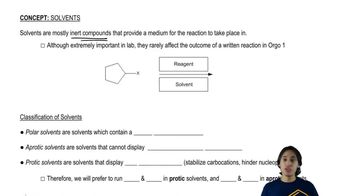
General format of reactions and how to interpret solvents.

Nucleophilicity and Solvent Polarity

Nucleophilicity refers to the ability of a nucleophile to donate an electron pair to an electrophile. In polar protic solvents, nucleophiles are often less nucleophilic due to solvation effects, while in polar aprotic solvents, nucleophiles remain more reactive. Understanding how solvent polarity affects nucleophilicity is crucial for predicting the direction of equilibrium in SN2 reactions.
추천 영상:
01:16
Identification of polarity in solvents