Ch. 9 - Substitution and Elimination Reactions of Alkyl Halides
Bruice - Organic Chemistry 8th Edition
Bruice8th EditionOrganic ChemistryISBN: 9780135213711당신이 사용하는 게 아니라요?교과서 변경
9장, 문제 108a

The rate of the reaction of methyl iodide with quinuclidine was measured in nitrobenzene, and then the rate of the reaction of methyl iodide with ­triethylamine was measured in the same solvent. The concentration of the reagents was the same in both experiments.
a.Which reaction had the larger rate constant?

검증된 단계별 안내
1
Step 1: Understand the problem. The question is asking which reaction has the larger rate constant when methyl iodide reacts with quinuclidine versus triethylamine in nitrobenzene, under identical concentrations.
Step 2: Recall the concept of nucleophilicity. Quinuclidine and triethylamine are both nucleophiles, but their nucleophilicity depends on factors such as steric hindrance and electronic effects. Quinuclidine is a bicyclic amine with less steric hindrance compared to triethylamine, which has bulky ethyl groups.
Step 3: Consider the solvent effect. Nitrobenzene is a polar aprotic solvent, which tends to enhance the nucleophilicity of amines by not stabilizing the nucleophile through hydrogen bonding. This means the intrinsic nucleophilicity of the amines will play a significant role in determining the rate constant.
Step 4: Relate nucleophilicity to the rate constant. In a reaction where the nucleophile attacks the electrophile (methyl iodide), a stronger nucleophile will generally lead to a faster reaction and a larger rate constant. Since quinuclidine is less sterically hindered and has a more accessible lone pair of electrons, it is likely to be a stronger nucleophile than triethylamine.
Step 5: Conclude the reasoning. Based on the steric and electronic considerations, the reaction of methyl iodide with quinuclidine is expected to have the larger rate constant compared to the reaction with triethylamine.

비슷한 문제에 대한 검증된 영상 답변:

이 영상 해법은 위 문제에 도움이 된다고 튜터들이 추천한 것입니다.
영상 길이:
5m

주요 개념

질문에 올바르게 답하기 위해 반드시 이해해야 하는 핵심 개념들은 다음과 같습니다.

Reaction Rate and Rate Constant

The reaction rate refers to the speed at which reactants are converted into products, while the rate constant (k) is a proportionality factor in the rate law that is specific to a given reaction at a certain temperature. It reflects the intrinsic reactivity of the reactants and is influenced by factors such as the nature of the reactants and the solvent. A higher rate constant indicates a faster reaction under the same conditions.
추천 영상:
가이드 코스
2:29
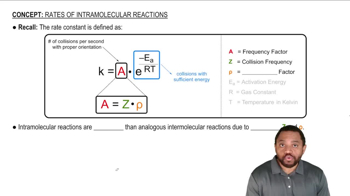
Rates of Intramolecular Reactions Concept 1

Nucleophilicity

Nucleophilicity is a measure of how readily a nucleophile donates an electron pair to form a bond with an electrophile. In this context, quinuclidine and triethylamine are both nucleophiles reacting with methyl iodide. The strength of the nucleophile affects the reaction rate; stronger nucleophiles typically lead to faster reactions, which is crucial for determining which reaction has a larger rate constant.
추천 영상:
08:27
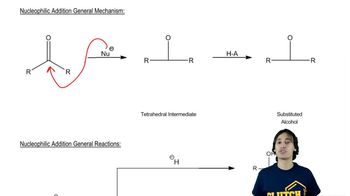
Nucleophilic Addition

Solvent Effects on Reaction Rates

The solvent can significantly influence the rate of a chemical reaction by stabilizing or destabilizing reactants, transition states, and products. Nitrobenzene, being a polar aprotic solvent, can affect the nucleophilicity of the reactants differently. Understanding how the solvent interacts with the nucleophiles and the electrophile is essential for predicting the relative rates of the reactions in question.
추천 영상:
가이드 코스
5:07
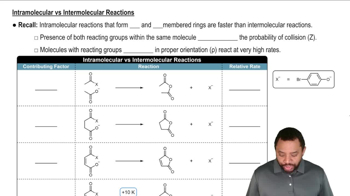
Rates of Intramolecular Reactions Concept 2