Ch. 9 - Substitution and Elimination Reactions of Alkyl Halides
Bruice - Organic Chemistry 8th Edition
Bruice8th EditionOrganic ChemistryISBN: 9780135213711당신이 사용하는 게 아니라요?교과서 변경
9장, 문제 106c

Show how each of the following compounds can be synthesized from the given starting materials:
c. Synthesis reaction showing the conversion of 1-bromopropane to a ketone compound.

검증된 단계별 안내
1
Step 1: Identify the starting material and the target compound. The starting material is 2-chloropropane, and the target compound is 2-methylbutanal. The transformation involves extending the carbon chain and introducing an aldehyde functional group.
Step 2: Perform a nucleophilic substitution reaction to replace the chlorine atom in 2-chloropropane with a cyanide group (-CN). This can be achieved using sodium cyanide (NaCN) in an aprotic solvent like DMSO. The product will be 2-methylpropanenitrile.
Step 3: Hydrolyze the nitrile group (-CN) in 2-methylpropanenitrile to form a carboxylic acid. This can be done using acidic or basic hydrolysis. For example, refluxing with aqueous HCl or NaOH will yield 2-methylpropanoic acid.
Step 4: Convert the carboxylic acid group in 2-methylpropanoic acid to an aldehyde group. This can be achieved using a reduction reaction, such as the Rosenmund reduction, which involves hydrogenation of the acid chloride (prepared from the carboxylic acid) using Pd/BaSO4 catalyst.
Step 5: Verify the structure of the final product, 2-methylbutanal, ensuring that the carbon chain has been extended and the aldehyde functional group is correctly positioned.

비슷한 문제에 대한 검증된 영상 답변:

이 영상 해법은 위 문제에 도움이 된다고 튜터들이 추천한 것입니다.
영상 길이:
7m

주요 개념

질문에 올바르게 답하기 위해 반드시 이해해야 하는 핵심 개념들은 다음과 같습니다.

Alkynes and Alkynide Ions

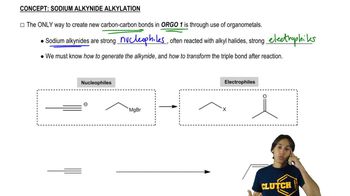
Alkynes are hydrocarbons containing at least one carbon-carbon triple bond. Alkynide ions are the conjugate bases of terminal alkynes, formed by deprotonation of the terminal hydrogen. These ions are strong nucleophiles and can participate in nucleophilic substitution reactions, allowing for the formation of new carbon-carbon bonds.
추천 영상:
03:19
Sodium Alkynide Alkylation

Nucleophilic Substitution Reactions

Nucleophilic substitution reactions involve the replacement of a leaving group in a molecule with a nucleophile. In the context of alkynide alkylation, the alkynide ion acts as the nucleophile, attacking an alkyl halide to form a new carbon-carbon bond. This reaction is fundamental in organic synthesis for building complex molecules.
추천 영상:
01:47
Nucleophiles and Electrophiles can react in Substitution Reactions.

Synthesis of Aldehydes

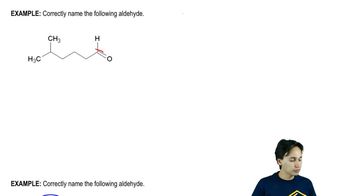
Aldehydes are organic compounds characterized by the presence of a carbonyl group (C=O) at the end of a carbon chain. They can be synthesized from alkynes through various methods, including hydroboration-oxidation or ozonolysis. Understanding the reactivity of alkynes and the conditions required for these transformations is crucial for effective synthesis.
추천 영상:
01:34
Name the aldehyde