Ch. 9 - Substitution and Elimination Reactions of Alkyl Halides
Bruice - Organic Chemistry 8th Edition
Bruice8th EditionOrganic ChemistryISBN: 9780135213711당신이 사용하는 게 아니라요?교과서 변경
9장, 문제 121

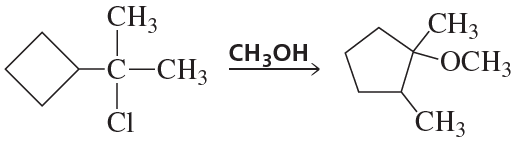
Propose a mechanism for the following reaction:
Chemical reaction diagram showing a substitution reaction with a chlorine atom replaced by a methoxy group.

검증된 단계별 안내
1
Step 1: Analyze the reactants and products. The starting material is a tertiary alkyl chloride, and the product is an ether. The reaction occurs in ethanol (C₂H₅OH), which suggests that ethanol acts as both the solvent and the nucleophile.
Step 2: Recognize the reaction type. This is likely an SN1 reaction because the substrate is a tertiary alkyl chloride, which favors the formation of a stable carbocation intermediate.
Step 3: Initiate the mechanism. The reaction begins with the dissociation of the C-Cl bond in the tertiary alkyl chloride, forming a carbocation intermediate. This step is facilitated by the polar protic solvent ethanol.
Step 4: Nucleophilic attack. The ethanol molecule (C₂H₅OH) acts as the nucleophile and attacks the carbocation, forming a new bond between the oxygen atom of ethanol and the carbon atom of the carbocation.
Step 5: Proton transfer. The positively charged oxygen atom in the intermediate loses a proton (H⁺) to another ethanol molecule or the solvent, resulting in the formation of the ether product.

비슷한 문제에 대한 검증된 영상 답변:

이 영상 해법은 위 문제에 도움이 된다고 튜터들이 추천한 것입니다.
영상 길이:
6m

주요 개념

질문에 올바르게 답하기 위해 반드시 이해해야 하는 핵심 개념들은 다음과 같습니다.

Nucleophilic Substitution Reactions

Nucleophilic substitution reactions involve the replacement of a leaving group (like Cl) by a nucleophile (like ethyl alcohol). In this process, the nucleophile donates a pair of electrons to form a new bond, while the leaving group departs with its electrons. Understanding the mechanism, whether it follows an SN1 or SN2 pathway, is crucial for predicting the outcome of the reaction.
추천 영상:
01:47
Nucleophiles and Electrophiles can react in Substitution Reactions.

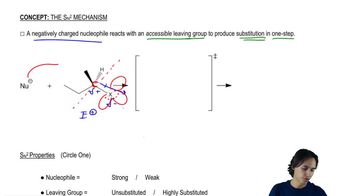
Mechanism of SN2 Reactions

In an SN2 reaction, the nucleophile attacks the electrophilic carbon atom from the opposite side of the leaving group, leading to a concerted mechanism where bond formation and bond breaking occur simultaneously. This results in an inversion of configuration at the carbon center. Recognizing the stereochemical implications is important for understanding the product's structure.
추천 영상:
08:33
Drawing the SN2 Mechanism

Role of Solvents in Organic Reactions

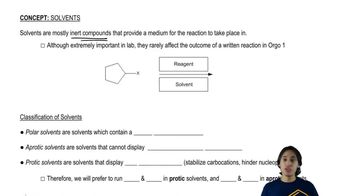
The choice of solvent can significantly influence the rate and outcome of organic reactions. Polar protic solvents can stabilize ions and facilitate SN1 mechanisms, while polar aprotic solvents favor SN2 reactions by enhancing nucleophilicity. In this reaction, the presence of ethyl alcohol as a solvent and nucleophile suggests a potential for an SN2 mechanism, impacting the reaction dynamics.
추천 영상:
02:26
General format of reactions and how to interpret solvents.