Which of the following substitution reactions would you expect to occur more quickly? Explain your answer.
Ch. 12 - Substitution and Elimination: Reactions of Haloalkanes

Mullins1st EditionOrganic Chemistry: A Learner Centered ApproachISBN: 9780137566471당신이 사용하는 게 아니라요?교과서 변경
11장, 문제 66b
Give a mechanism for the following substitution and elimination reactions.
(b) 
검증된 단계별 안내1
Step 1: Analyze the reactants and products. The reactant is a tertiary alkyl bromide, and the product is an alkene. The reaction involves elimination, likely an E2 mechanism due to the presence of a strong base (ethanol).
Step 2: Identify the base and its role. Ethanol (CH3CH2OH) acts as a nucleophile and base, facilitating the elimination of the bromide group and a proton from a β-carbon.
Step 3: Determine the β-hydrogens available for elimination. The tertiary carbon bonded to bromine has adjacent β-carbons with hydrogens that can be abstracted by the base.
Step 4: Describe the elimination mechanism. The base abstracts a β-hydrogen, forming a double bond between the α-carbon (attached to bromine) and the β-carbon. Simultaneously, the bromide ion leaves as a leaving group.
Step 5: Confirm the product formation. The major product is the more substituted alkene (Zaitsev's rule), which is the one shown in the image. This occurs because the elimination favors the formation of the more stable alkene.

비슷한 문제에 대한 검증된 영상 답변:
이 영상 해법은 위 문제에 도움이 된다고 튜터들이 추천한 것입니다.
주요 개념
질문에 올바르게 답하기 위해 반드시 이해해야 하는 핵심 개념들은 다음과 같습니다.
Nucleophilic Substitution Mechanisms
Nucleophilic substitution reactions involve the replacement of a leaving group by a nucleophile. The two primary mechanisms are SN1 and SN2. SN1 is a two-step process where the leaving group departs first, forming a carbocation, followed by nucleophilic attack. In contrast, SN2 is a one-step mechanism where the nucleophile attacks the substrate simultaneously as the leaving group departs, leading to an inversion of configuration.
추천 영상:
Nucleophiles and Electrophiles can react in Substitution Reactions.
Elimination Reactions
Elimination reactions involve the removal of a small molecule, typically water or hydrogen halide, from a larger molecule, resulting in the formation of a double bond. The two main types are E1 and E2. E1 is a two-step process similar to SN1, where a carbocation intermediate is formed before the elimination occurs. E2 is a concerted mechanism where the base abstracts a proton while the leaving group departs, often requiring strong bases and specific stereochemistry.
추천 영상:
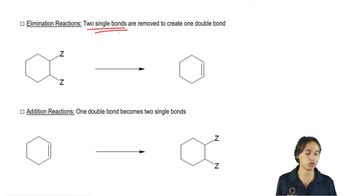
Recognizing Elimination Reactions.
Regioselectivity and Stereoselectivity
Regioselectivity refers to the preference of a chemical reaction to yield one structural isomer over others, while stereoselectivity indicates the preference for one stereoisomer over another. In substitution and elimination reactions, these concepts are crucial for predicting the major products. Factors influencing regio- and stereoselectivity include the structure of the substrate, the nature of the nucleophile or base, and the reaction conditions.
추천 영상:
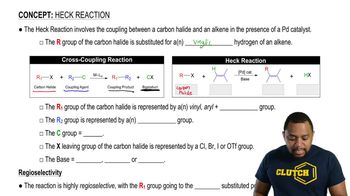
Heck Reaction
관련 실천
교과서 질문
926
views
교과서 질문
When the reaction scheme in Assessment 12.63 is done on a monosubstituted alkene, at least three equivalents of base are needed. Reacting the product of step 2 with D–Cl (D is an isotope of H) incorporates deuterium at the terminal carbon. Explain these two observations.
1081
views
교과서 질문
Give a mechanism for the following substitution and elimination reactions.
(c)
1239
views
교과서 질문
The following chlorocyclohexane undergoes neither Sₙ2 nor E2 under the conditions shown. Why?
1491
views
교과서 질문
Give a mechanism for the following substitution and elimination reactions.
(a)
1101
views
교과서 질문
In addition to using mCPBA, epoxides can be synthesized from alkenes in the two-step process shown. Give a mechanism for each step of the process.
1110
views