


Ch. 12 - Substitution and Elimination: Reactions of Haloalkanes
Mullins - Organic Chemistry: A Learner Centered Approach 1st Edition
Mullins1st EditionOrganic Chemistry: A Learner Centered ApproachISBN: 9780137566471당신이 사용하는 게 아니라요?교과서 변경
11장, 문제 67

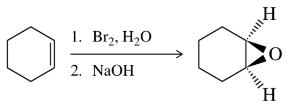
In addition to using mCPBA, epoxides can be synthesized from alkenes in the two-step process shown. Give a mechanism for each step of the process.

검증된 단계별 안내
1
Step 1: Analyze the reaction conditions for the first step. The alkene reacts with bromine (Br₂) in the presence of water (H₂O). This leads to the formation of a bromohydrin. The mechanism involves the electrophilic addition of Br₂ to the alkene, forming a bromonium ion intermediate. Water then attacks the more substituted carbon of the bromonium ion, leading to the formation of the bromohydrin.
Step 2: Write the detailed mechanism for the first step. The alkene's π electrons attack Br₂, forming a cyclic bromonium ion. Water acts as a nucleophile and attacks the more substituted carbon of the bromonium ion, opening the ring and forming the bromohydrin with anti stereochemistry.
Step 3: Analyze the reaction conditions for the second step. The bromohydrin reacts with NaOH, a strong base, to form the epoxide. The base deprotonates the hydroxyl group of the bromohydrin, creating an alkoxide ion. This alkoxide ion then performs an intramolecular nucleophilic substitution, displacing the bromine atom and forming the epoxide.
Step 4: Write the detailed mechanism for the second step. The hydroxyl group of the bromohydrin is deprotonated by NaOH, forming an alkoxide ion. The alkoxide ion attacks the carbon bonded to bromine in an intramolecular SN2 reaction, displacing the bromine and forming the epoxide.
Step 5: Confirm the stereochemistry of the product. The epoxide retains the anti stereochemistry of the bromohydrin due to the intramolecular nature of the reaction. This ensures that the substituents on the epoxide are trans to each other.

비슷한 문제에 대한 검증된 영상 답변:

이 영상 해법은 위 문제에 도움이 된다고 튜터들이 추천한 것입니다.
영상 길이:
7m

주요 개념

질문에 올바르게 답하기 위해 반드시 이해해야 하는 핵심 개념들은 다음과 같습니다.

Epoxide Formation

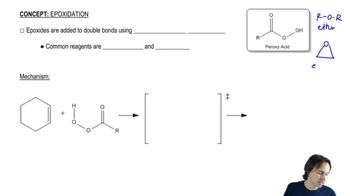
Epoxides are three-membered cyclic ethers formed from alkenes through various methods, including the reaction with peracids like mCPBA. The formation involves the electrophilic attack of the peracid on the double bond of the alkene, leading to the creation of the epoxide ring. Understanding this mechanism is crucial for predicting the stereochemistry and regioselectivity of the reaction.
추천 영상:
02:19
General properties of epoxidation.

Mechanism of Electrophilic Addition

The mechanism of electrophilic addition involves the initial formation of a cyclic intermediate when an electrophile reacts with a nucleophile. In the case of epoxide synthesis, the alkene acts as a nucleophile, while the peracid provides the electrophilic oxygen. This stepwise process is essential for understanding how the epoxide is formed and the subsequent reactions that may occur.
추천 영상:
05:39
Features of Addition Mechanisms.

Stereochemistry of Epoxides

Stereochemistry plays a significant role in the formation of epoxides, as the configuration of the starting alkene influences the stereochemical outcome of the epoxide. The reaction can lead to different stereoisomers depending on the orientation of the substituents on the alkene. Recognizing how stereochemistry affects the mechanism is vital for predicting the properties and reactivity of the resulting epoxide.
추천 영상:
가이드 코스
1:38
Polymer Stereochemistry Concept 1