Ch. 24 - Benzene 2: Reactions Influenced by the Aromatic Ring
Mullins - Organic Chemistry: A Learner Centered Approach 1st Edition
Mullins1st EditionOrganic Chemistry: A Learner Centered ApproachISBN: 9780137566471당신이 사용하는 게 아니라요?교과서 변경
23장, 문제 1

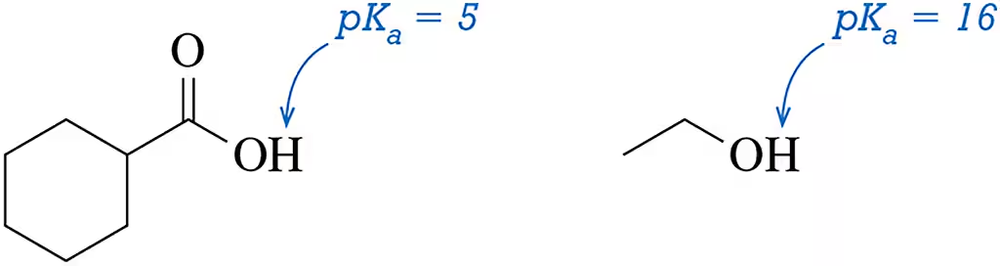
A carboxylic acid ( pKa = 5) is 1011 times more acidic than an alcohol (pKa = 16). Why?
Carboxylic acid structure with pKₐ = 5, compared to alcohol structure with pKₐ = 16, illustrating acidity difference.

검증된 단계별 안내
1
Step 1: Understand the concept of pKa. The pKa value is a measure of the acidity of a compound. Lower pKa values indicate stronger acids, while higher pKa values indicate weaker acids. Here, the carboxylic acid has a pKa of 5, and the alcohol has a pKa of 16, meaning the carboxylic acid is significantly more acidic.
Step 2: Compare the stability of the conjugate bases. When an acid donates a proton, it forms its conjugate base. The stability of the conjugate base is a key factor in determining the acidity of the acid. The carboxylic acid forms a carboxylate ion (R-COO⁻), which is stabilized by resonance. The alcohol forms an alkoxide ion (R-O⁻), which lacks resonance stabilization.
Step 3: Analyze resonance stabilization in the carboxylate ion. The carboxylate ion has two oxygen atoms that share the negative charge through resonance. This delocalization of charge makes the conjugate base more stable, which in turn makes the carboxylic acid more acidic.
Step 4: Consider the electronegativity of oxygen. Both carboxylic acids and alcohols have oxygen atoms, but in carboxylic acids, the carbonyl group (C=O) further increases the electron-withdrawing effect. This effect stabilizes the negative charge on the conjugate base, enhancing the acidity of the carboxylic acid.
Step 5: Relate the pKa difference to the acidity difference. The difference in pKa values (16 - 5 = 11) corresponds to a factor of 10¹¹ in acidity. This exponential relationship arises because pKa is logarithmic, meaning small changes in pKa result in large changes in acidity.

비슷한 문제에 대한 검증된 영상 답변:

이 영상 해법은 위 문제에 도움이 된다고 튜터들이 추천한 것입니다.

주요 개념

질문에 올바르게 답하기 위해 반드시 이해해야 하는 핵심 개념들은 다음과 같습니다.

Acidity and pKₐ

Acidity in organic chemistry is often measured using the pKₐ value, which indicates the strength of an acid. A lower pKₐ value corresponds to a stronger acid, meaning it dissociates more readily in solution to release protons (H⁺). In this case, the carboxylic acid with a pKₐ of 5 is significantly stronger than the alcohol with a pKₐ of 16, making it more likely to donate a proton.
추천 영상:
02:23
Using factors affecting acidity to rank acids

Carboxylic Acids vs. Alcohols

Carboxylic acids contain a carboxyl group (-COOH) that can easily lose a proton, while alcohols have a hydroxyl group (-OH) that is less likely to do so. The resonance stabilization of the carboxylate ion formed after deprotonation enhances the acidity of carboxylic acids, making them much stronger acids compared to alcohols, which do not benefit from such stabilization.
추천 영상:
04:20
Carboxylic Acids Nomenclature

Comparative Acidity

The comparative acidity of different functional groups can be understood through their ability to stabilize the negative charge after losing a proton. In this scenario, the carboxylic acid is 10¹¹ times more acidic than the alcohol, indicating that the carboxylate ion formed is much more stable than the alkoxide ion from the alcohol, thus favoring the dissociation of the carboxylic acid.
추천 영상:
02:41
Comparing hydrocarbon acidity