Ch. 24 - Benzene 2: Reactions Influenced by the Aromatic Ring
Mullins - Organic Chemistry: A Learner Centered Approach 1st Edition
Mullins1st EditionOrganic Chemistry: A Learner Centered ApproachISBN: 9780137566471당신이 사용하는 게 아니라요?교과서 변경
23장, 문제 2

What reagent would you use to brominate the allylic carbon of cyclohexene?
Chemical reaction showing cyclohexene converting to bromocyclohexene with a question mark indicating missing reagent.

검증된 단계별 안내
1
Identify the allylic position in cyclohexene. The allylic position is the carbon atom adjacent to the double bond. In cyclohexene, this would be the carbon atoms next to the double bond in the ring structure.
Understand the concept of allylic bromination. Allylic bromination involves the substitution of a hydrogen atom at the allylic position with a bromine atom.
Consider the reagents typically used for allylic bromination. N-bromosuccinimide (NBS) is a common reagent used for this purpose because it selectively brominates the allylic position without affecting the double bond.
Recognize the role of NBS in the presence of a radical initiator. NBS works effectively in the presence of a radical initiator, such as light or heat, which helps generate bromine radicals necessary for the reaction.
Conclude that N-bromosuccinimide (NBS) in the presence of a radical initiator is the appropriate reagent for brominating the allylic carbon of cyclohexene.

비슷한 문제에 대한 검증된 영상 답변:

이 영상 해법은 위 문제에 도움이 된다고 튜터들이 추천한 것입니다.
영상 길이:
4m

주요 개념

질문에 올바르게 답하기 위해 반드시 이해해야 하는 핵심 개념들은 다음과 같습니다.

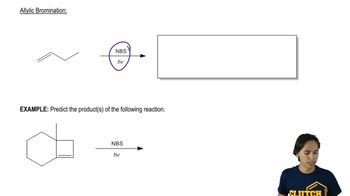
Allylic Bromination

Allylic bromination is a chemical reaction that involves the substitution of a hydrogen atom at the allylic position (the carbon atom adjacent to a double bond) with a bromine atom. This reaction is typically facilitated by radical mechanisms, making it selective for the allylic position due to the stability of the resulting allylic radical.
추천 영상:
00:54
Mechanism of Allylic Bromination.

Radical Mechanism

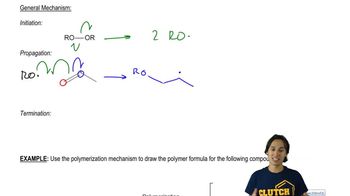
Radical mechanisms involve the formation and reaction of radicals, which are highly reactive species with unpaired electrons. In allylic bromination, radicals are generated by the homolytic cleavage of bonds, often initiated by heat or light, leading to the selective bromination of allylic positions due to the stability of allylic radicals.
추천 영상:
03:28
The mechanism of Radical Polymerization.

N-Bromosuccinimide (NBS)

N-Bromosuccinimide (NBS) is a reagent commonly used for allylic bromination. It provides a controlled source of bromine radicals, facilitating the selective bromination of allylic positions in alkenes like cyclohexene. NBS is preferred due to its ability to generate bromine radicals under mild conditions, minimizing side reactions and ensuring high selectivity.
추천 영상:
가이드 코스
3:06
Synthesis of Amino Acids: N-Phthalimidomalonic Ester Synthesis Concept 1