
For each of the products you predicted in Assessment 8.39, provide an arrow-pushing mechanism which rationalizes the formation of each product. Make sure your mechanism accounts for all products formed, including stereoisomers and regioisomers, where applicable.
Ch. 8 - Alkenes 1: Properties and Electrophilic Additions

Mullins1st EditionOrganic Chemistry: A Learner Centered ApproachISBN: 9780137566471당신이 사용하는 게 아니라요?교과서 변경
7장, 문제 39b
Provide the expected product for the reaction of each of the following alkenes with H2SO4 and H2O.
(b) 
검증된 단계별 안내1
Step 1: Identify the functional group in the given molecule. The structure contains an alkene functional group (a double bond) in a cyclic compound.
Step 2: Understand the reaction conditions. The reaction involves H2SO4 (sulfuric acid) and H2O (water), which typically leads to an acid-catalyzed hydration of the alkene. This reaction follows Markovnikov's rule.
Step 3: Apply Markovnikov's rule. In acid-catalyzed hydration, the hydrogen atom from H2O will add to the carbon of the double bond with more hydrogens (less substituted), and the hydroxyl group (-OH) will add to the carbon with fewer hydrogens (more substituted).
Step 4: Consider carbocation stability. During the reaction, a carbocation intermediate is formed. The stability of the carbocation is crucial, and rearrangements may occur to form a more stable carbocation (e.g., tertiary carbocation).
Step 5: Draw the expected product. After the addition of H2O, the double bond is replaced by a single bond, and an -OH group is added to the more substituted carbon of the original double bond, resulting in an alcohol product.

비슷한 문제에 대한 검증된 영상 답변:
이 영상 해법은 위 문제에 도움이 된다고 튜터들이 추천한 것입니다.
주요 개념
질문에 올바르게 답하기 위해 반드시 이해해야 하는 핵심 개념들은 다음과 같습니다.
Electrophilic Addition
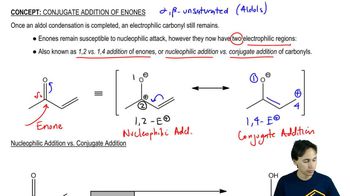
Electrophilic addition is a fundamental reaction mechanism in organic chemistry where an electrophile reacts with a nucleophile, typically involving alkenes. In the presence of strong acids like H₂SO₄, the double bond of the alkene acts as a nucleophile, attacking the electrophilic hydrogen, leading to the formation of a carbocation intermediate. This step is crucial for understanding how alkenes react with acids and water.
추천 영상:
1,2 vs 1,4 Addition
Carbocation Stability
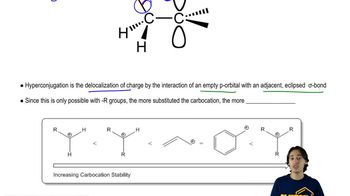
Carbocation stability is a key concept in organic reactions, as the stability of the carbocation intermediate significantly influences the reaction pathway and product formation. Carbocations can be classified as primary, secondary, or tertiary, with tertiary carbocations being the most stable due to hyperconjugation and inductive effects. Understanding the stability of these intermediates helps predict the major product of the reaction.
추천 영상:
Determining Carbocation Stability
Hydration Reaction
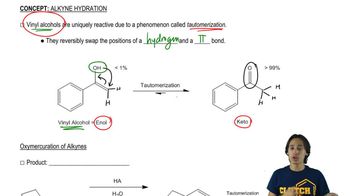
The hydration reaction involves the addition of water (H₂O) to an alkene, resulting in the formation of an alcohol. In the context of the reaction with H₂SO₄, the acid first protonates the alkene to form a carbocation, which is then attacked by water. This process is essential for converting alkenes into alcohols and is a common method for synthesizing alcohols in organic chemistry.
추천 영상:
Alkyne Hydration
관련 실천
교과서 질문
1148
views
교과서 질문
Radical addition to alkenes is not effective for the synthesis of iodo- and chloroalkanes. Using your knowledge of the mechanism of this reaction, along with bond dissociation energies, explain why the radical additions of HI and HCl are not effective. (Assume ∆H = 65 kcal/ mol for the C–C π bond.)
1002
views
교과서 질문
Provide the expected product for the reaction of each of the following alkenes with H2SO4 and H2O.
(d)
903
views
교과서 질문
Provide the alkene that would give the following alcohols under acid-catalyzed hydration conditions.
(a)
1189
views
교과서 질문
Which reagent system (HBr or HBr, H2O2) would you use to carry out the following transformations?
(c)
743
views
교과서 질문
Provide the expected product for the reaction of each of the following alkenes with H2SO4 and H2O.
(a)
1222
views
