Ch. 8 - Alkenes 1: Properties and Electrophilic Additions
Mullins - Organic Chemistry: A Learner Centered Approach 1st Edition
Mullins1st EditionOrganic Chemistry: A Learner Centered ApproachISBN: 9780137566471당신이 사용하는 게 아니라요?교과서 변경
7장, 문제 38

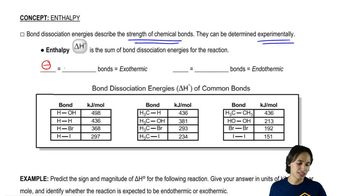
Radical addition to alkenes is not effective for the synthesis of iodo- and chloroalkanes. Using your knowledge of the mechanism of this reaction, along with bond dissociation energies, explain why the radical additions of HI and HCl are not effective. (Assume ∆H = 65 kcal/ mol for the C–C π bond.)

검증된 단계별 안내
1
Radical addition to alkenes involves the formation of a radical intermediate, which is crucial for the propagation step in the reaction mechanism. The initiation step typically involves the homolytic cleavage of a bond to generate radicals.
In the case of HI and HCl, the bond dissociation energies (BDE) for H-I and H-Cl are relatively high compared to H-Br. This means that the energy required to break these bonds and form radicals is significant, making the initiation step less favorable.
The propagation step involves the addition of the radical to the alkene, forming a new radical. The stability of this new radical is important for the reaction to proceed. Iodine and chlorine radicals are less stable compared to bromine radicals, which affects the overall reaction kinetics.
The overall reaction must be exothermic for the radical addition to proceed effectively. The bond dissociation energy of the C-C π bond is given as 65 kcal/mol, which must be overcome. The energy released from forming new bonds must compensate for this, which is not the case for HI and HCl due to their high BDEs.
Therefore, the radical addition of HI and HCl to alkenes is not effective because the initiation step is energetically unfavorable, and the propagation step does not lead to a sufficiently stable radical intermediate, resulting in an overall endothermic process.

비슷한 문제에 대한 검증된 영상 답변:

이 영상 해법은 위 문제에 도움이 된다고 튜터들이 추천한 것입니다.
영상 길이:
10m

주요 개념

질문에 올바르게 답하기 위해 반드시 이해해야 하는 핵심 개념들은 다음과 같습니다.

Radical Addition Mechanism

Radical addition to alkenes involves the formation of radicals that initiate a chain reaction, adding across the double bond. The process typically requires a radical initiator, such as peroxides, to generate radicals from hydrogen halides. The stability of the radical intermediates and the energy required for bond formation are crucial factors in determining the feasibility of the reaction.
추천 영상:
05:39
Features of Addition Mechanisms.

Bond Dissociation Energy

Bond dissociation energy (BDE) is the energy required to break a bond homolytically, forming two radicals. In radical reactions, the BDE of the hydrogen-halide bond influences the reaction's progress. For HI and HCl, the BDEs are relatively low, making the formation of radicals less favorable compared to other halides like HBr, which has a more suitable BDE for radical formation.
추천 영상:
04:09
How to calculate enthalpy using bond dissociation energies.

Thermodynamic Considerations

Thermodynamics play a critical role in radical reactions, where the overall enthalpy change (∆H) determines the reaction's favorability. The given ∆H for the C–C π bond is 65 kcal/mol, indicating the energy required to break the double bond. For HI and HCl, the radical addition is not thermodynamically favorable due to insufficient energy release from the formation of C–I and C–Cl bonds, making the reaction non-spontaneous.
추천 영상:
08:51
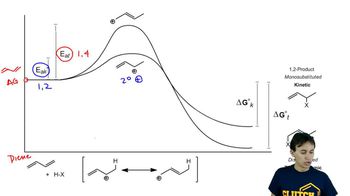
Kinetic vs. Thermodynamic Control