

Radical addition to alkenes is not effective for the synthesis of iodo- and chloroalkanes. Using your knowledge of the mechanism of this reaction, along with bond dissociation energies, explain why the radical additions of HI and HCl are not effective. (Assume ∆H = 65 kcal/ mol for the C–C π bond.)
Ch. 8 - Alkenes 1: Properties and Electrophilic Additions

Mullins1st EditionOrganic Chemistry: A Learner Centered ApproachISBN: 9780137566471당신이 사용하는 게 아니라요?교과서 변경
7장, 문제 37c
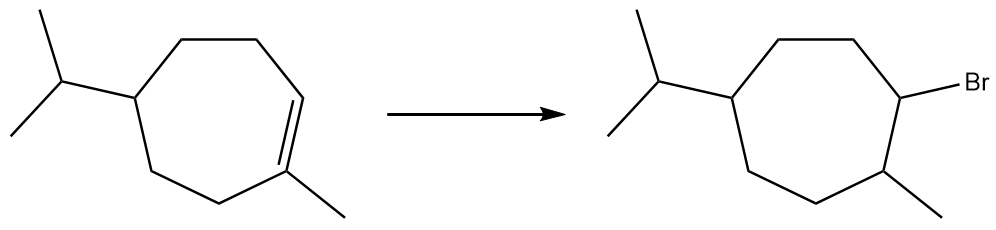
Which reagent system (HBr or HBr, H2O2) would you use to carry out the following transformations?
(c) 
검증된 단계별 안내1
Identify the type of reaction: The transformation involves the addition of bromine (Br) to an alkene, which is a typical electrophilic addition reaction.
Consider the regioselectivity: The product shows bromine added to the less substituted carbon of the double bond, indicating anti-Markovnikov addition.
Select the reagent system: Anti-Markovnikov addition of HBr to alkenes is achieved using HBr in the presence of peroxides (H₂O₂).
Understand the mechanism: The presence of peroxides leads to the formation of free radicals, which initiate the anti-Markovnikov addition by adding Br to the less substituted carbon.
Conclude the reagent choice: For the given transformation, use HBr with H₂O₂ to achieve the desired anti-Markovnikov addition of bromine.

비슷한 문제에 대한 검증된 영상 답변:
이 영상 해법은 위 문제에 도움이 된다고 튜터들이 추천한 것입니다.
영상 길이:
3m주요 개념
질문에 올바르게 답하기 위해 반드시 이해해야 하는 핵심 개념들은 다음과 같습니다.
Markovnikov's Rule
Markovnikov's Rule states that in the addition of HX to an alkene, the hydrogen atom will attach to the carbon with the greater number of hydrogen atoms already attached, while the halide (X) will attach to the carbon with fewer hydrogen atoms. This rule helps predict the major product of electrophilic addition reactions.
추천 영상:
The 18 and 16 Electron Rule
Anti-Markovnikov Addition
Anti-Markovnikov addition occurs when the addition of HX to an alkene results in the halide attaching to the less substituted carbon atom. This is typically facilitated by the presence of peroxides (like H2O2) in the reaction, which alters the mechanism and leads to the formation of the less stable radical intermediate.
추천 영상:
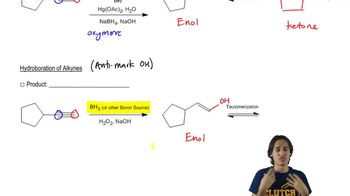
Anti-Markovnikov addition of alcohols to terminal alkynes yields aldehydes
Reagent Selection in Organic Reactions
Choosing the appropriate reagent system is crucial in organic chemistry as it influences the reaction pathway and the final product. In this case, HBr alone would lead to Markovnikov addition, while HBr in the presence of H2O2 promotes anti-Markovnikov addition, making it essential to select the right system based on the desired outcome.
추천 영상:
Identifying organic molecules
관련 실천
교과서 질문
1002
views
교과서 질문
Which reagent system (HBr or HBr, H2O2) would you use to carry out the following transformations?
(a)
983
views
교과서 질문
Provide the expected product for the reaction of each of the following alkenes with H2SO4 and H2O.
(b)
742
views
교과서 질문
Provide the expected product for the reaction of each of the following alkenes with H2SO4 and H2O.
(a)
1222
views
교과서 질문
Provide an arrow-pushing mechanism that rationalizes the formation of each of the products you predicted in Assessment 8.35 (ii). Make sure your mechanism accounts for all products formed, including stereoisomers and regioisomers, where applicable.
996
views
교과서 질문
Which reagent system (HBr or HBr, H2O2) would you use to carry out the following transformations?
(b)
1035
views
