Ch. 22 - Condensations and Alpha Substitutions of Carbonyl Compounds
Wade - Organic Chemistry 9th Edition
Wade9th EditionOrganic ChemistryISBN: 9780135213728당신이 사용하는 게 아니라요?교과서 변경
22장, 문제 57

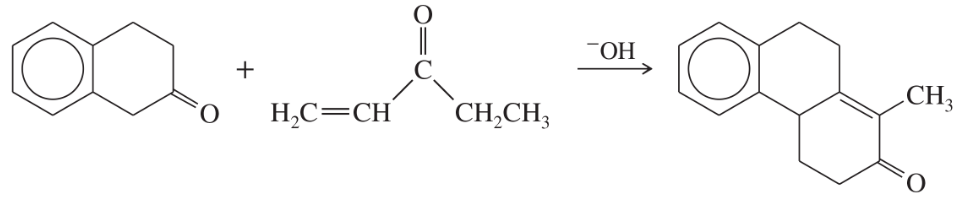
Propose a mechanism for the following reaction.

검증된 단계별 안내
1
Step 1: Analyze the reactants and products. The reaction involves two ketones: 1-tetralone and methyl vinyl ketone, reacting in the presence of hydroxide (HO⁻). The product is a fused bicyclic compound with a new C-C bond formed between the two reactants. This suggests a Michael addition followed by aldol condensation.
Step 2: Initiate the reaction mechanism with the enolate formation. The hydroxide ion deprotonates the alpha-carbon of 1-tetralone, forming an enolate ion. The enolate is stabilized by resonance between the alpha-carbon and the carbonyl group.
Step 3: Perform the Michael addition. The enolate ion attacks the beta-carbon of methyl vinyl ketone (a conjugated ketone), forming a new C-C bond. This step results in the formation of a new intermediate with the two reactants connected.
Step 4: Proceed with aldol condensation. The intermediate formed undergoes intramolecular aldol condensation. The hydroxide ion deprotonates the alpha-carbon adjacent to the newly formed ketone, generating another enolate. This enolate attacks the carbonyl group within the same molecule, forming a cyclic structure.
Step 5: Complete the reaction with dehydration. The aldol product undergoes elimination of water (dehydration) to form the final conjugated bicyclic product. This step is facilitated by the basic conditions provided by hydroxide.

비슷한 문제에 대한 검증된 영상 답변:

이 영상 해법은 위 문제에 도움이 된다고 튜터들이 추천한 것입니다.
영상 길이:
10m

주요 개념

질문에 올바르게 답하기 위해 반드시 이해해야 하는 핵심 개념들은 다음과 같습니다.

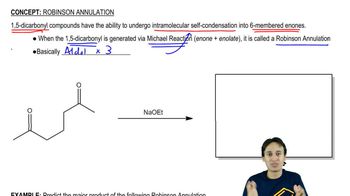
Robinson Annulation

The Robinson Annulation is a key reaction in organic chemistry that involves the formation of a six-membered ring through a series of reactions, typically involving a Michael addition followed by an intramolecular aldol condensation. This mechanism is crucial for synthesizing complex cyclic structures and is widely used in the synthesis of steroids and other natural products.
추천 영상:
04:12
Robinson Annulation

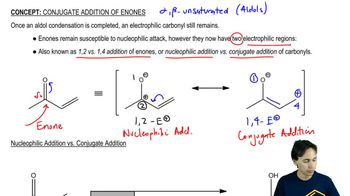
Michael Addition

The Michael addition is a nucleophilic addition reaction where a nucleophile adds to an α,β-unsaturated carbonyl compound. This step is essential in the Robinson Annulation mechanism, as it forms a new carbon-carbon bond, setting the stage for subsequent reactions that lead to ring formation and product synthesis.
추천 영상:
09:23
1,2 vs 1,4 Addition

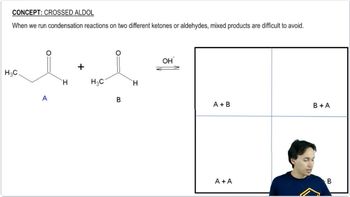
Aldol Condensation

Aldol condensation is a reaction between aldehydes or ketones that results in the formation of β-hydroxy carbonyl compounds, which can further dehydrate to form α,β-unsaturated carbonyl compounds. In the context of the Robinson Annulation, this step is critical for closing the ring and stabilizing the final product through the formation of double bonds.
추천 영상:
09:51
Crossed Aldol