Ch. 22 - Condensations and Alpha Substitutions of Carbonyl Compounds
Wade - Organic Chemistry 9th Edition
Wade9th EditionOrganic ChemistryISBN: 9780135213728당신이 사용하는 게 아니라요?교과서 변경
22장, 문제 56f

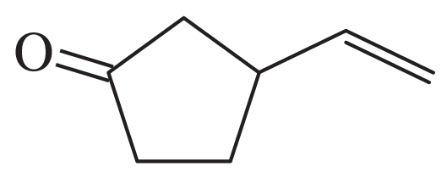
Show how the following products might be synthesized from suitable Michael donors and acceptors.
(f)

검증된 단계별 안내
1
Step 1: Identify the product structure. The given product is a cyclic ketone with an α,β-unsaturated side chain. This suggests that the synthesis involves a Michael addition reaction, where a nucleophilic donor adds to an α,β-unsaturated acceptor.
Step 2: Determine the Michael donor. A suitable Michael donor for this reaction would be a compound with an active methylene group, such as diethyl malonate or ethyl acetoacetate. These compounds have acidic hydrogens that can be deprotonated to form a nucleophilic enolate.
Step 3: Determine the Michael acceptor. The α,β-unsaturated side chain in the product indicates that the acceptor should be an α,β-unsaturated carbonyl compound, such as methyl vinyl ketone or acrylaldehyde.
Step 4: Outline the reaction mechanism. The Michael donor is first deprotonated using a base (e.g., NaOH or KOH) to form the enolate ion. The enolate then attacks the β-carbon of the Michael acceptor in a conjugate addition reaction, forming a new C-C bond.
Step 5: Cyclization and final product formation. After the Michael addition, the intermediate undergoes intramolecular cyclization to form the five-membered ring. This step may involve additional base or acid catalysis to facilitate ring closure and tautomerization to yield the final cyclic ketone product.

비슷한 문제에 대한 검증된 영상 답변:

이 영상 해법은 위 문제에 도움이 된다고 튜터들이 추천한 것입니다.
영상 길이:
2m

주요 개념

질문에 올바르게 답하기 위해 반드시 이해해야 하는 핵심 개념들은 다음과 같습니다.

Michael Addition

Michael addition is a nucleophilic addition reaction where a nucleophile adds to an α,β-unsaturated carbonyl compound. In this reaction, a Michael donor, typically a compound with a nucleophilic site, attacks the electrophilic carbon of the double bond in the unsaturated carbonyl, forming a new carbon-carbon bond. This reaction is fundamental in organic synthesis for constructing complex molecules.
추천 영상:
09:23
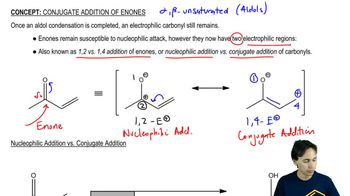
1,2 vs 1,4 Addition

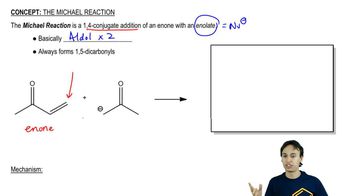
Michael Donors and Acceptors

Michael donors are nucleophiles that can donate electrons to form a bond with an electrophilic site, while Michael acceptors are typically α,β-unsaturated carbonyl compounds that can accept electrons. Common Michael donors include enolates and other nucleophilic species, whereas common acceptors include acrylates and maleimides. Understanding the nature of these species is crucial for predicting the outcomes of Michael addition reactions.
추천 영상:
02:34
General Reaction

Synthesis Pathways

Synthesis pathways refer to the step-by-step methods used to construct a target molecule from simpler starting materials. In the context of Michael addition, identifying suitable donors and acceptors is essential for designing effective synthesis pathways. This involves considering the reactivity, stability, and functional groups of the reactants to achieve the desired product, as illustrated by the cyclic compound in the question.
추천 영상:
가이드 코스
2:13
Energy Production In Biochemical Pathways Concept 1