Ch. 22 - Condensations and Alpha Substitutions of Carbonyl Compounds
Wade - Organic Chemistry 9th Edition
Wade9th EditionOrganic ChemistryISBN: 9780135213728당신이 사용하는 게 아니라요?교과서 변경
22장, 문제 58

The base-catalyzed reaction of an aldehyde (having no α hydrogens) with an anhydride is called the Perkin condensation. Propose a mechanism for the following example of the Perkin condensation. (Sodium acetate serves as the base.)

검증된 단계별 안내
1
Step 1: Identify the reactants and the role of the base. The reaction involves benzaldehyde (an aldehyde with no α-hydrogens) and acetic anhydride. Sodium acetate acts as the base to initiate the reaction by deprotonating acetic anhydride.
Step 2: Deprotonation of acetic anhydride. Sodium acetate abstracts a proton from the methyl group of acetic anhydride, forming an enolate ion. The enolate ion is stabilized by resonance, with the negative charge delocalized between the oxygen atoms and the carbon atom.
Step 3: Nucleophilic attack of the enolate ion on benzaldehyde. The enolate ion acts as a nucleophile and attacks the carbonyl carbon of benzaldehyde, forming a tetrahedral intermediate. This intermediate collapses, regenerating the carbonyl group and forming a β-hydroxy intermediate.
Step 4: Elimination of water to form the α,β-unsaturated product. Under the reaction conditions (heat), the β-hydroxy intermediate undergoes dehydration (loss of water) to form cinnamic acid, which is an α,β-unsaturated carboxylic acid.
Step 5: Formation of acetic acid as a byproduct. During the reaction, acetic acid is formed as a byproduct from the hydrolysis of acetic anhydride and the action of the base. The final products are cinnamic acid and acetic acid.

비슷한 문제에 대한 검증된 영상 답변:

이 영상 해법은 위 문제에 도움이 된다고 튜터들이 추천한 것입니다.
영상 길이:
8m

주요 개념

질문에 올바르게 답하기 위해 반드시 이해해야 하는 핵심 개념들은 다음과 같습니다.

Perkin Condensation

The Perkin condensation is a reaction between an aldehyde and an anhydride, typically in the presence of a base, to form α,β-unsaturated carboxylic acids. This reaction is significant in organic synthesis as it allows for the formation of carbon-carbon bonds. In this specific case, the aldehyde lacks α-hydrogens, which influences the reaction pathway and product formation.
추천 영상:
05:53
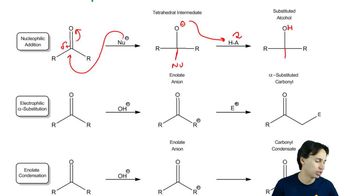
Condensation Reactions

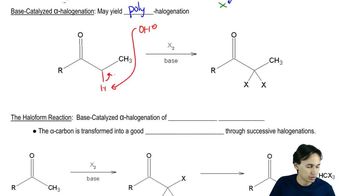
Mechanism of Base-Catalyzed Reactions

Base-catalyzed reactions involve the use of a base to facilitate the reaction process, often by deprotonating a substrate to generate a more reactive species. In the context of the Perkin condensation, sodium acetate acts as the base, which helps in the formation of the enolate ion from the aldehyde. This enolate then attacks the anhydride, leading to the formation of the desired product.
추천 영상:
01:57
Base Catalyzed

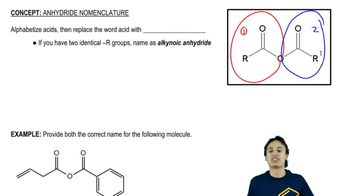
Role of Anhydrides in Organic Reactions

Anhydrides are reactive compounds that can participate in various organic reactions, including acylation and condensation reactions. In the Perkin condensation, the anhydride provides an acyl group that reacts with the enolate formed from the aldehyde. This reaction is crucial for forming the carbon-carbon bond and ultimately leads to the production of α,β-unsaturated carboxylic acids.
추천 영상:
03:35
Anhydride Nomenclature