Ch. 22 - Condensations and Alpha Substitutions of Carbonyl Compounds
Wade - Organic Chemistry 9th Edition
Wade9th EditionOrganic ChemistryISBN: 9780135213728당신이 사용하는 게 아니라요?교과서 변경
22장, 문제 47c,d

Show how the following compounds can be made using the malonic ester synthesis.
(c) 4-phenylbutanoic acid
(d) cyclopentanecarboxylic acid

검증된 단계별 안내
1
Step 1: Understand the malonic ester synthesis. This is a method used to synthesize carboxylic acids by alkylating the alpha-carbon of diethyl malonate (or another malonic ester) followed by hydrolysis and decarboxylation. The key steps involve enolate formation, alkylation, hydrolysis, and decarboxylation.
Step 2: For 4-phenylbutanoic acid, identify the target structure. The molecule has a phenyl group attached to the fourth carbon of a butanoic acid chain. To achieve this, start with diethyl malonate and generate the enolate ion by treating it with a strong base such as sodium ethoxide (NaOEt).
Step 3: Perform alkylation. React the enolate ion with an appropriate alkyl halide, such as benzyl bromide (C6H5CH2Br), to introduce the phenyl group. This step forms a substituted malonic ester intermediate with a benzyl group attached to the alpha-carbon.
Step 4: Hydrolyze the ester groups. Treat the substituted malonic ester with aqueous acid (H3O+) or base (NaOH) to hydrolyze both ester groups into carboxylic acids, forming a dicarboxylic acid intermediate.
Step 5: Decarboxylate the dicarboxylic acid. Heat the dicarboxylic acid intermediate to remove one carboxyl group as CO2, yielding 4-phenylbutanoic acid. Repeat a similar process for cyclopentanecarboxylic acid, but use an alkyl halide like 1-bromopentane to form a cyclopentyl group during alkylation.

비슷한 문제에 대한 검증된 영상 답변:

이 영상 해법은 위 문제에 도움이 된다고 튜터들이 추천한 것입니다.
영상 길이:
5m

주요 개념

질문에 올바르게 답하기 위해 반드시 이해해야 하는 핵심 개념들은 다음과 같습니다.

Malonic Ester Synthesis

Malonic ester synthesis is a method for synthesizing carboxylic acids by using malonic ester as a key intermediate. This reaction involves the alkylation of malonic ester followed by hydrolysis and decarboxylation, allowing for the introduction of alkyl groups. It is particularly useful for creating compounds with a specific carbon chain length and functional groups.
추천 영상:
가이드 코스
3:33
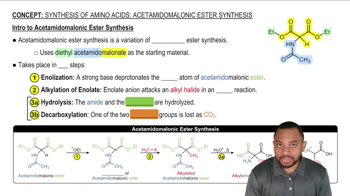
Synthesis of Amino Acids: Acetamidomalonic Ester Synthesis Concept 1

Alkylation

Alkylation is a chemical process where an alkyl group is transferred to a molecule, typically through a nucleophilic substitution reaction. In the context of malonic ester synthesis, the alkylation step is crucial as it determines the structure of the final carboxylic acid product. The choice of alkyl halide used in this step influences the carbon skeleton of the resulting compound.
추천 영상:
03:19
Sodium Alkynide Alkylation

Decarboxylation

Decarboxylation is the process of removing a carboxyl group from a molecule, resulting in the release of carbon dioxide. In malonic ester synthesis, decarboxylation occurs after hydrolysis of the alkylated malonic ester, leading to the formation of the desired carboxylic acid. This step is essential for achieving the final product with the correct structure and functional groups.
추천 영상:
02:32
Predict the correct structure