Ch. 22 - Condensations and Alpha Substitutions of Carbonyl Compounds
Wade - Organic Chemistry 9th Edition
Wade9th EditionOrganic ChemistryISBN: 9780135213728당신이 사용하는 게 아니라요?교과서 변경
22장, 문제 49

Show the ketones that would result from hydrolysis and decarboxylation of the following β-keto esters.

검증된 단계별 안내
1
Step 1: Understand the reaction mechanism. Hydrolysis of β-keto esters involves breaking the ester bond in the presence of water and acid/base, forming a β-keto acid. Decarboxylation then removes the carboxyl group as CO₂, leaving behind a ketone.
Step 2: Analyze structure (a). The β-keto ester contains a phenyl group (PhCH₂), a methyl group (CH₃), and an ethyl ester group (COOC₂H₅). Hydrolysis will convert the ester group into a carboxylic acid, and decarboxylation will remove the carboxyl group, leaving a ketone with the phenyl and methyl groups attached to the central carbon.
Step 3: Analyze structure (b). The β-keto ester contains a cyclobutane ring, a methyl group (CH₃), and an ethyl ester group (COOCH₂CH₃). Hydrolysis will convert the ester group into a carboxylic acid, and decarboxylation will remove the carboxyl group, leaving a ketone with the cyclobutane ring and methyl group attached to the central carbon.
Step 4: Analyze structure (c). The β-keto ester contains a cyclopentanone ring and an ethyl ester group (OCH₂CH₃). Hydrolysis will convert the ester group into a carboxylic acid, and decarboxylation will remove the carboxyl group, leaving a ketone with the cyclopentanone ring intact.
Step 5: Summarize the results. For each β-keto ester, the hydrolysis and decarboxylation reactions yield a ketone. The specific ketone depends on the substituents attached to the β-keto ester structure. Ensure you understand how the ester group is hydrolyzed and how the carboxyl group is removed during decarboxylation.

비슷한 문제에 대한 검증된 영상 답변:

이 영상 해법은 위 문제에 도움이 된다고 튜터들이 추천한 것입니다.
영상 길이:
3m

주요 개념

질문에 올바르게 답하기 위해 반드시 이해해야 하는 핵심 개념들은 다음과 같습니다.

β-Keto Esters

β-keto esters are organic compounds that contain both a ketone and an ester functional group, with the carbonyl of the ketone located at the β position relative to the ester group. This structure allows for unique reactivity, particularly in reactions involving hydrolysis and decarboxylation, which can lead to the formation of ketones. Understanding the structure and reactivity of β-keto esters is crucial for predicting the products of these reactions.
추천 영상:
02:39
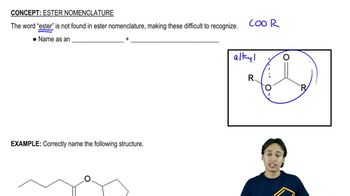
Ester Nomenclature

Hydrolysis

Hydrolysis is a chemical reaction involving the breakdown of a compound by water, often resulting in the formation of an alcohol and a carboxylic acid from esters. In the context of β-keto esters, hydrolysis can lead to the release of the ketone and the corresponding carboxylic acid. This reaction is typically catalyzed by acids or bases and is essential for understanding how β-keto esters can be transformed into simpler ketones.
추천 영상:
가이드 코스
1:00
Hydrolysis of Thioesters Concept 2

Decarboxylation

Decarboxylation is the process of removing a carboxyl group from a molecule, releasing carbon dioxide (CO2). In the case of β-keto esters, after hydrolysis, the resulting carboxylic acid can undergo decarboxylation, leading to the formation of a ketone. This reaction is significant in organic synthesis as it allows for the generation of ketones from β-keto esters, which are valuable intermediates in various chemical processes.
추천 영상:
02:32
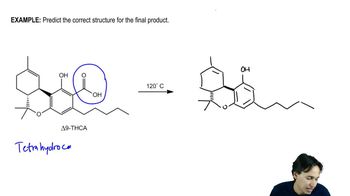
Predict the correct structure