Degrees of Vertices: 동영상 및 연습문제
Degrees of Vertices focuses on finding the degree of a vertex by counting how many edges are connected to it. This can be done from a graph drawing or directly from a list of edges by identifying every edge that contains the vertex. Vertices that share an edge are adjacent, and recognizing adjacency helps confirm which connections contribute to a vertex’s degree.
The topic also includes parity, which tells whether a vertex has even or odd degree. A vertex with degree 0 is an isolated vertex. In many courses, degree 0 is treated as even, though some sources may treat it differently. A key rule is that a loop counts as one edge but adds 2 to the degree, so loops must be handled carefully when labeling degrees and parity.
Students should be able to identify degrees, classify vertices as even or odd, recognize isolated vertices, and use degree counts to describe the structure of a graph clearly and accurately.
Degrees of Vertices


Label the degree and parity (even/odd) of each vertex on each graph.
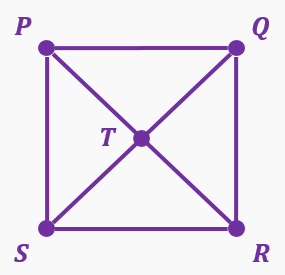
P = 3-odd; Q = 6-even; R = 9-odd; S = 12-even; T = 4-even
P = 3-odd; Q = 6-even; R = 9-odd; S = 12-even; T = 16-even
P = 3-odd; Q = 3-odd; R = 3-odd; S = 3-odd; T = 4-even
P = 2-odd; Q = 3-odd; R = 3-odd; S = 3-odd; T = 4-even
Label the degree and parity (even/odd) of each vertex on each graph.
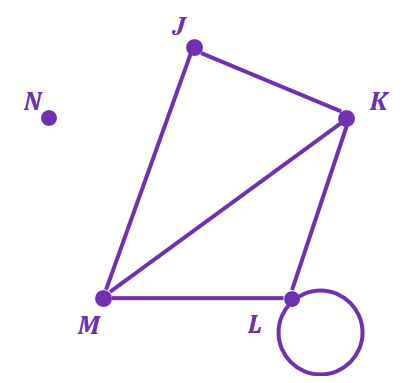
J = 2-even; K = 3-odd; L = 4-even; M = 3-odd; N = 4-even
J = 2-even; K = 3-odd; L = 4-even; M = 3-odd; N = 0-even
J = 2-even; K = 5-odd; L = 9-odd; M = 12-even; N = 0-even
J = 2-even; K = 5-odd; L = 9-odd; M = 12-even; N = 16-even
Label the degree and parity (even/odd) of each vertex on each graph.
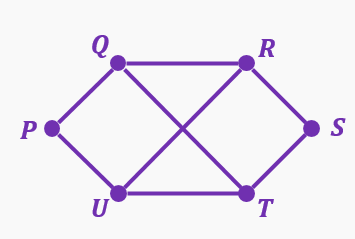
P = 2-even; Q = 3-odd; R = 3-odd; S = 2-even; T = 3-odd; U = 3-odd
P = 2-even; Q = 3-odd; R = 3-odd; S = 2-even; T = 3-odd; U = 4-even
P = 2-even; Q = 5-odd; R = 8-even; S = 10-even; T = 13-odd; U = 16-even
P = 2-even; Q = 5-odd; R = 8-even; S = 10-even; T = 13-odd; U = 17-odd
Determine which graph fits the criteria: exactly five vertices and four odd vertices.
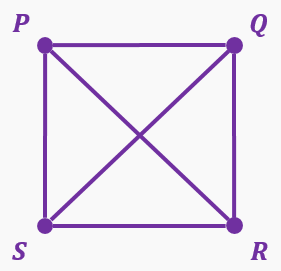
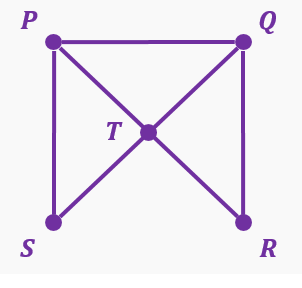
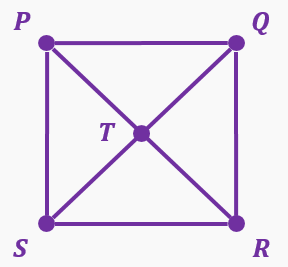
Graph is composed of vertices , and edges .
Which vertices are adjacent to vertex ?
Graph is composed of vertices , and edges .
Find the degree of vertex .
4
1
3
11
Degrees of Vertices Example 1
Degrees of Vertices Example 2
학생들이 이 주제에 대해 묻는 질문은 다음과 같습니다:
The degree of a vertex in a graph is the number of edges connected to that vertex. To determine the degree, you count all edges that include the vertex. This can be done by examining a graph drawing or by looking at a list of edges and identifying which ones contain the vertex. Each edge contributes one to the degree count, except for loops, which are edges that connect a vertex to itself. A loop counts as one edge but adds 2 to the degree of the vertex because it touches the vertex twice. Understanding the degree helps describe the connectivity of the vertex within the graph.
In graph theory, a loop is an edge that connects a vertex to itself. While a loop counts as a single edge, it contributes 2 to the degree of the vertex because it touches the vertex at two points. This means when calculating the degree of a vertex, you must add 2 for each loop present. This is important because loops increase the degree more than regular edges, affecting the parity (even or odd nature) of the vertex's degree. Properly accounting for loops ensures accurate degree counts and helps in analyzing the graph's structure.
An isolated vertex is a vertex with degree 0, meaning it has no edges connected to it. In many graph theory contexts, a vertex with degree 0 is considered even because zero is an even number. However, some sources may treat it differently depending on the context. Recognizing isolated vertices is important because they represent points in the graph that are disconnected from the rest of the structure. Identifying these vertices helps in understanding the overall connectivity and components of the graph.
To determine if a vertex has an even or odd degree, first count the number of edges connected to it, including counting loops as 2. If the total number of edges connected to the vertex is divisible by 2, then the vertex has an even degree. If it is not divisible by 2, the vertex has an odd degree. This classification is called parity. Knowing the parity of vertices is useful in many graph theory problems, such as Eulerian paths and circuits, where the parity of vertices plays a crucial role in determining the existence of such paths.
Adjacency refers to vertices that share an edge. When determining the degree of a vertex, identifying which vertices are adjacent helps confirm which edges contribute to the degree count. Each edge connecting the vertex to an adjacent vertex adds one to the degree. Understanding adjacency is essential because it clarifies the connections in the graph and ensures accurate counting of edges for the degree. This concept also helps in analyzing the graph's structure, such as identifying clusters or components.