Euler's Theorems: 동영상 및 연습문제
Euler's Theorems are used to decide whether a graph has an Euler path, an Euler circuit, or neither by counting odd vertices. A vertex is odd if it has an odd number of edges connected to it, and even if it has an even number. The key results are: a graph with 0 odd vertices has an Euler circuit, a graph with exactly 2 odd vertices has an Euler path, and a graph with more than 2 odd vertices has neither.
An Euler path or Euler circuit must trace each edge exactly once. When building one with Fleury's algorithm, first determine whether a path or circuit exists using the number of odd vertices. If there are 2 odd vertices, start at one of the odd vertices; if there are 0 odd vertices, start at any vertex. Then choose edges one at a time, avoiding a bridge unless it is the last available option, so the remaining graph does not split before all edges are used.
Euler's Theorems


Determine if the graph has an Euler path (E.P.), an Euler circuit (E.C.), or neither.
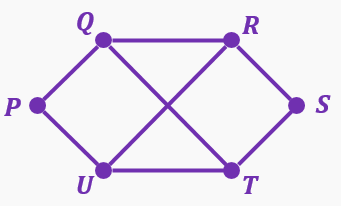
E.P.
E.C.
NEITHER
Determine if the graph has an Euler path (E.P.), an Euler circuit (E.C.), or neither.
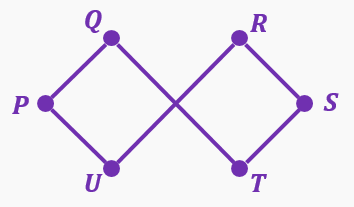
E.P.
E.C.
NEITHER
Determine if the graph has an Euler path (E.P.), an Euler circuit (E.C.), or neither.
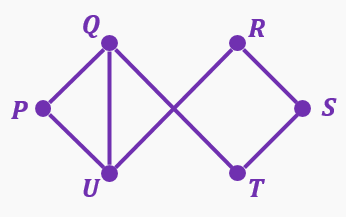
E.P.
E.C.
NEITHER
Euler's Theorems Example 1
Fleury's Algorithm
Use Fleury’s alg. to find an Euler path or circuit.
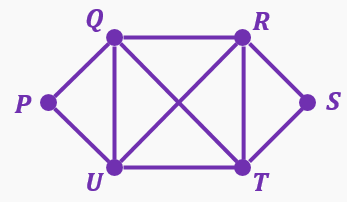
Use Fleury’s alg. to find an Euler path or circuit.
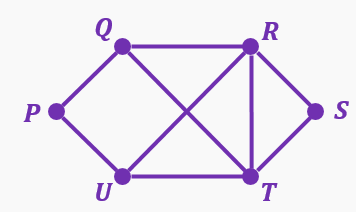
Fleury's Algorithm Example 2
학생들이 이 주제에 대해 묻는 질문은 다음과 같습니다:
Euler's Theorem in graph theory helps us determine whether a graph contains an Euler path or an Euler circuit by analyzing the degrees of its vertices. A vertex's degree is the number of edges connected to it. According to the theorem, if a graph has zero vertices with an odd degree, it contains an Euler circuit, which is a path that starts and ends at the same vertex and uses every edge exactly once. If the graph has exactly two vertices with an odd degree, it contains an Euler path, which uses every edge exactly once but starts and ends at different vertices. If there are more than two odd vertices, the graph has neither an Euler path nor an Euler circuit. This theorem is fundamental for solving problems involving traversing all edges without repetition.
To apply Euler's Theorem, you first need to identify odd and even vertices in the graph. A vertex is considered odd if it has an odd number of edges connected to it, and even if it has an even number of edges. To find this, count the edges incident to each vertex. For example, if a vertex has 3 edges, it is odd; if it has 4 edges, it is even. This classification is crucial because the number of odd vertices determines whether an Euler path or circuit exists. Specifically, zero odd vertices mean an Euler circuit exists, exactly two odd vertices mean an Euler path exists, and more than two odd vertices mean neither exists.
Fleury's algorithm is a step-by-step method used to construct an Euler path or Euler circuit in a graph, provided one exists. First, determine if the graph has zero or two odd vertices using Euler's Theorem. If there are two odd vertices, start at one of them; if none, start at any vertex. Then, at each step, choose an edge to traverse, but avoid selecting a bridge (an edge whose removal would disconnect the graph) unless it is the only option left. This ensures the remaining graph stays connected, allowing you to use all edges exactly once. By following this process, Fleury's algorithm systematically traces an Euler path or circuit.
No, a graph with more than two odd vertices cannot have an Euler path or Euler circuit. According to Euler's Theorem, the existence of Euler paths and circuits depends on the number of vertices with an odd degree. Specifically, an Euler circuit requires zero odd vertices, and an Euler path requires exactly two odd vertices. If there are more than two odd vertices, it is impossible to traverse every edge exactly once without repeating edges or missing some. This is because the path would have to start and end at vertices with odd degrees, and having more than two odd vertices breaks this condition.
Unit fractions, also called conversion factors, are ratios of equivalent measures used to convert between units. For example, to convert feet to inches, use the fact that 1 foot equals 12 inches. You can write this as two unit fractions: or . To convert 14 feet to inches, multiply 14 feet by the unit fraction with the new unit (inches) in the numerator and the original unit (feet) in the denominator: . This cancels feet and leaves inches, so inches. Always place the new unit in the numerator and the original unit in the denominator to ensure proper cancellation.