Where does the citric acid cycle occur in eukaryotes?
a. in the cytosol of cells
b. in the intermembrane space of mitochondria
c. in the inner membrane of mitochondria
d. in the matrix of mitochondria
검증된 단계별 안내
1
Identify the location of the citric acid cycle within the cell.
Recall that the citric acid cycle is a key metabolic pathway that completes the breakdown of glucose derivatives.
Understand that the citric acid cycle occurs in a specific part of the mitochondria in eukaryotic cells.
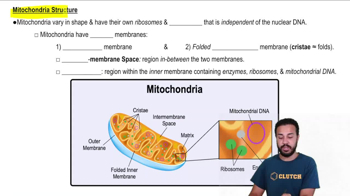
Consider the structure of the mitochondria, which includes the outer membrane, intermembrane space, inner membrane, and matrix.
Determine that the citric acid cycle takes place in the matrix of the mitochondria, where enzymes and substrates are available for the cycle's reactions.
비슷한 문제에 대한 검증된 영상 답변:
이 영상 해법은 위 문제에 도움이 된다고 튜터들이 추천한 것입니다.
영상 길이:
1m
영상 재생:
0 댓글
주요 개념
질문에 올바르게 답하기 위해 반드시 이해해야 하는 핵심 개념들은 다음과 같습니다.
Citric Acid Cycle (Krebs Cycle)
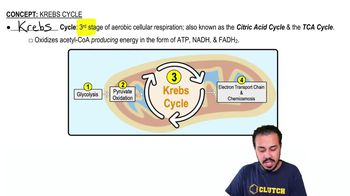
The citric acid cycle, also known as the Krebs cycle, is a series of chemical reactions used by all aerobic organisms to generate energy. It plays a crucial role in cellular respiration by oxidizing acetyl-CoA to produce ATP, NADH, and FADH2, which are essential for energy production.
Mitochondria are double-membraned organelles found in eukaryotic cells, responsible for energy production. They consist of an outer membrane, an inner membrane, and an intermembrane space, with the matrix being the innermost compartment where the citric acid cycle occurs.
In eukaryotic cells, the citric acid cycle occurs in the mitochondrial matrix. This location is critical as it provides the necessary environment and enzymes for the cycle to efficiently convert acetyl-CoA into energy-rich molecules, which are then utilized in the electron transport chain.

 1:55분
1:55분 검증된 단계별 안내
 01:37
01:37